Nifty heads toward weakest Samvat of Modi era after 13% fall


 London
 9 °C

 Manchester
10 °C
 Glasgow
 10 °C
 Dublin
 9 °C
 Belfast
8 °C
 Washington
 15 °C
 Denver
 13 °C
 Atlanta
 19 °C
 Dallas
26 °C
 Houston Texas
 25 °C
 New Orleans
24 °C
 El Paso
26 °C
 Phoenix
28 °C
 Los Angeles
26 °C
San Diego
26 °C
San Francisco
21 °C
Chicago
22 °C
Minneapolis
12 °C
Seattle
12 °C
Portland
 10 °C
Salt Lake City
14 °C
Las Vegas
23 °C
Miami
24 °C
Jacksonville
 19 °C
San Antonio
27 °C
Bermuda
 21 °C
Nassau
14 °C
Iqaluit
 -4 °C
Yellowknife
1 °C
Anchorage
5 °C
Fairbanks
1 °C
Barrow
1 °C
Calgary
1 °C
Edmonton
20 °C
Winnipeg
4 °C
Goose Bay
12 °C
Halifax
11 °C
Boston
13 °C
Ottawa
15 °C
Toronto
15 °C
Detroit
18 °C
Cleveland
17 °C
New York
16 °C
Baltimore
14 °C
Philadelphia
14 °C
Nuuk (Godthåb)
-5 °C
Hong Kong
25 °C
Singapore
26 °C
Melbourne
25 °C
Canberra
13 °C
Adelaide
11 °C
Darwin
30 °C
Perth
13 °C
Fort Worth
26 °C
Honolulu
28 °C
Sydney
18 °C
Johannesburg
19 °C
Dubai
30 °C
Mumbai
29 °C
Zürich
8 °C
Tokyo
19 °C
Seoul
15 °C
Delhi
19 °C
Beijing
10 °C
Riyadh
27 °C
Prague
8 °C
Pennsylvania
12 °C
Valletta
20 °C
Manama
30 °C
Warsaw
8 °C
Stockholm
10 °C
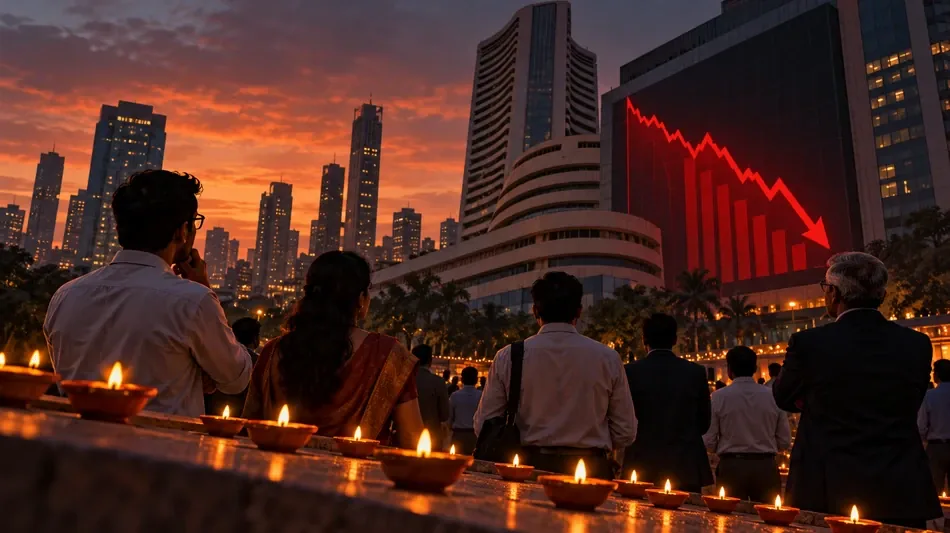
The Nifty is down about 13% in Samvat 2082, putting Indian equities on course for their weakest Samvat year since Narendra Modi took office in 2014.
The Nifty is down about 13% in Samvat 2082, putting Indian equities on course for their weakest Samvat year since Narendra Modi took office in 2014.
Samvat 2082 is shaping up to be the worst Samvat year for investors since Prime Minister Narendra Modi assumed office in 2014. The Nifty is down around 13 per cent so far in the current Samvat year, a far steeper decline than the previous worst-performing Samvat of 2078 (3 November 2021 to 21 October 2022), when the benchmark index fell 1.4 per cent amid aggressive global interest-rate hikes, soaring inflation and the fallout from the Russia-Ukraine conflict.
The sharp correction stands in contrast to the strong gains investors have enjoyed over much of the past decade. Samvat 2080 delivered returns of 24.6 per cent, while Samvat 2077 saw a spectacular 40.2 per cent rally on the back of post-pandemic recovery and abundant global liquidity. Between Samvat 2071 to 2081, the market have registered an average return of 12 per cent.
No signs of turnaround
“The current market phase is unusual because it lacks the normal signs of a turnaround that often emerge before a new Samvat begins, said Anand James, Chief Market Strategist at Geojit Financial Services. “This is the first time we are entering a Samvat period without visible signs of bottoming out,” James said.
He noted that the Nifty has slipped back to levels seen in May 2026 while India VIX has climbed above 30, signalling elevated uncertainty among traders. Beneath the surface, the damage has been even more severe.
“The mood is quite negative, though it is not fully reflected in the Nifty because a few heavyweight stocks, particularly in IT and PSU banking, have held up the benchmark,” he said.
While small-cap stocks have corrected far more sharply than frontline indices, indicating broader weakness across the market, investors continue to struggle to identify fresh triggers capable of reigniting risk appetite.
Rising crude oil prices, inching towards $120 per barrel, inflation concerns, geopolitical risks and signs of slowing liquidity have all contributed to the cautious mood. While funds locked in recent IPOs may eventually return to secondary markets, marketmen believe the weakness cannot be explained by liquidity factors alone.
“When money becomes dearer, money will look at growth. It won’t go to a market just for safety, they’ll go for growth,” said Dinshaw Irani, MD & CEO, Helios Capital Asset Management.
Separately, drawing comparisons with 2019, before the pandemic-led bull run, the current conditions resemble a prolonged phase of consolidation rather than the beginning of a new structural uptrend.
“We are going into the crucial Samvat period with a sense of caution,” James said, warning that further downside cannot be ruled out despite markets trading near important support levels.
Irani believes India’s structural growth story remains intact despite near-term volatility. “Markets will always face phases of volatility, but India’s structural growth drivers remain stronger than ever. We believe investors should look beyond the noise and focus on companies delivering sustainable growth, because over time the market rewards growth and quality above everything else,” Irani said.
T.Murray--SMC