German Auto Giants Face Existential Crisis as China Sales Plummet


 London
 6 °C

 Manchester
7 °C
 Glasgow
 2 °C
 Dublin
8 °C
 Belfast
 9 °C
 Washington
14 °C
 Denver
8 °C
 Atlanta
15 °C
 Dallas
 16 °C
 Houston Texas
22 °C
 New Orleans
20 °C
 El Paso
15 °C
 Phoenix
21 °C
 Los Angeles
21 °C
San Diego
 21 °C
San Francisco
16 °C
Chicago
6 °C
Minneapolis
3 °C
Seattle
13 °C
Portland
13 °C
Salt Lake City
6 °C
Las Vegas
19 °C
Miami
25 °C
Jacksonville
 23 °C
San Antonio
18 °C
Bermuda
24 °C
Nassau
16 °C
Iqaluit
 0 °C
Yellowknife
-3 °C
Anchorage
-1 °C
Fairbanks
-1 °C
Barrow
-5 °C
Calgary
9 °C
Edmonton
8 °C
Winnipeg
3 °C
Goose Bay
11 °C
Halifax
17 °C
Boston
17 °C
Ottawa
11 °C
Toronto
6 °C
Detroit
7 °C
Cleveland
6 °C
New York
17 °C
Baltimore
14 °C
Philadelphia
15 °C
Nuuk (Godthåb)
-2 °C
Hong Kong
 27 °C
Singapore
29 °C
Melbourne
25 °C
Canberra
18 °C
Adelaide
19 °C
Darwin
33 °C
Perth
 26 °C
Fort Worth
16 °C
Honolulu
 25 °C
Sydney
29 °C
Johannesburg
16 °C
Dubai
26 °C
Mumbai
30 °C
Zürich
8 °C
Tokyo
 20 °C
Seoul
7 °C
Delhi
17 °C
Beijing
7 °C
Riyadh
23 °C
Prague
-1 °C
Pennsylvania
16 °C
Valletta
16 °C
Manama
29 °C
Warsaw
0 °C
Stockholm
2 °C
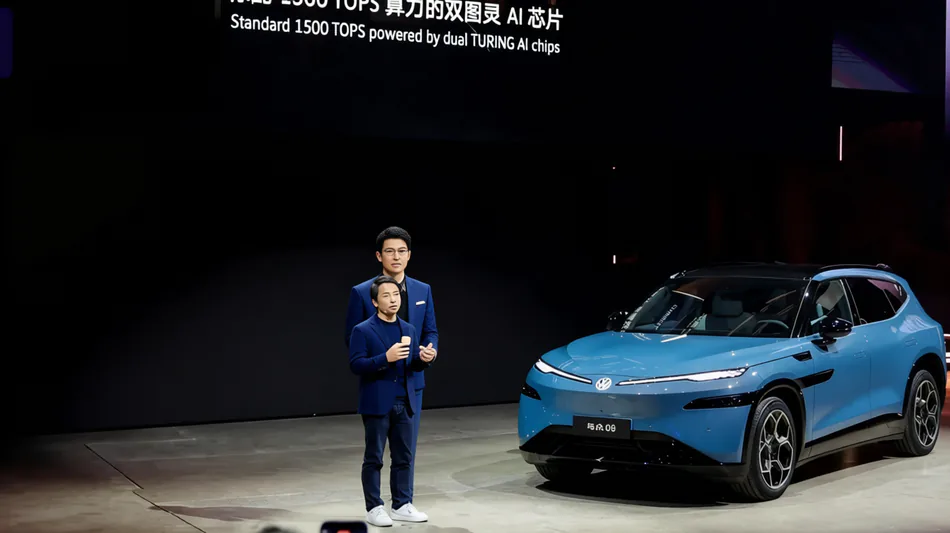
Volkswagen, Mercedes-Benz, and BMW are grappling with a severe existential crisis in China, where their once-profitable operations have turned into significant financial burdens. As Chinese competitors dominate the market with superior technology and pricing, German automakers are forced to confront plunging sales figures and consider radical strategic shifts to stem the bleeding.
Volkswagen, Mercedes-Benz, and BMW are confronting an existential crisis in China, where their automotive operations have shifted from being profit engines to significant financial liabilities. As domestic Chinese rivals dominate the market with advanced technology and aggressive pricing, the German automakers are forced to reassess their strategies amid plunging sales figures and intensifying competition.
The scale of the downturn was starkly illustrated by recent financial adjustments. Volkswagen and Mercedes-Benz have written down the value of their China businesses significantly and are reporting red ink for the first time in their local entities. BMW does not publish separate results for the region but is widely understood to be operating in a similar accounting zone.
Sales volumes are falling sharply, with figures this year tracking 20 to 40 percent below already weak levels from the previous year. The situation marks a dramatic reversal from just three and a half years ago, when German executives first realized the extent of the competitive threat posed by Chinese manufacturers at an auto show following the pandemic.
Thomas Luk, an independent automotive consultant with German roots who lives in Hefei and Stuttgart, described the situation as a "total failure of the China strategy." He criticized German manufacturers for failing to understand local consumer preferences, noting that their autonomous driving systems are not class-leading and their interior designs resemble those from the 1980s.
"The vehicle does not promise enough value compared to the Chinese," Luk said. He outlined two potential paths forward: either German brands must rapidly develop vehicles with superior autonomous systems, cockpit intelligence, and chassis technology to regain competitiveness, or they must sell their operations and exit the market entirely. He argued that a complete withdrawal is preferable to a slow retreat, as it would stop financial losses more quickly.
Despite these warnings, executives at the major German firms have been reluctant to abandon China. They continue to believe that brand heritage and engineering prowess can still win over Chinese buyers. BMW’s new CEO, Milan Nedeljković, recently emphasized that China remains a central focus for the company. He pointed to the delayed rollout of the Neue Klasse electric vehicles, including the iX3, which is arriving in China six months later than elsewhere due to necessary local adaptations.
Nedeljković acknowledged this delay as a typical failure of manufacturers who do not conduct research and development locally. He stated that future efforts would prioritize strengthening local R&D and procurement. Even the Mini brand, which sells poorly in China, will remain on the market. Nedeljković justified this by noting that all compact electric vehicles face difficulties in the region but promised to inject new energy into the brand.
Audi is taking a different approach by expanding its local presence. CEO Gernot Döllner is building out a new China-focused marque, AUDI, developed jointly with state-owned SAIC. The company has opened an Innovation & Technology Center in Shanghai staffed by approximately 300 engineers who will develop electric vehicles from concept to production. Döllner called China a key market for Audi and responded to poor business conditions by replacing the China head, Johannes Roschek, with Jeff Zhang, a native Chinese national.
Mercedes-Benz leadership has expressed confusion over the market's behavior. CEO Ola Källenius admitted that the hard reality in what was once a growth country is difficult to comprehend. "The behavior of the market in China is hard to understand," he said. He noted that headquarters in Stuttgart hope each month that sales have hit bottom, only to see further declines.
Mercedes has announced a restructuring of its China business and is evaluating which regions might offset the losses. Källenius stated, "We must look at which markets offer better profit pools." The difficulties are impacting overall financial targets; Mercedes now plans an operating margin for its automotive division in 2026 between two and three percent, down from previous estimates of three to five percent. Its medium-term target of eight to ten percent is also under pressure.
At Volkswagen, Ralf Brandstätter, the board member responsible for China business, highlighted a worsening environment in an internal memo. He noted that while the company is accelerating its product and technology offensive, the overall market is deteriorating. Sales are declining, electrification is accelerating, and price and technology competition is intensifying.
Volkswagen expects the total Chinese car market to shrink to approximately 18.8 million vehicles this year, a fifth less than the record year of 2017. In response, VW is adopting a strategy already used by local rivals like BYD, Nio, and Geely: exporting excess capacity. Brandstätter aims to expand rapidly into the "Global South" with models produced in China to access new markets and profit potential.
Porsche faces a distinct but equally challenging reality. Having never manufactured locally in China, the sports car maker is no longer waiting for sales stabilization. Instead, it has lowered its annual sales forecast for China to between 20,000 and 25,000 vehicles—a drop of 80 percent from peak levels five years ago.
Porsche CEO Michael Leiters considers this realistic and plans to ensure that cars sold in China no longer serve to fill capacity at German factories. This represents the most radical step taken by any of the German automakers to stop financial bleeding in the region.
P.M.Martin--SMC