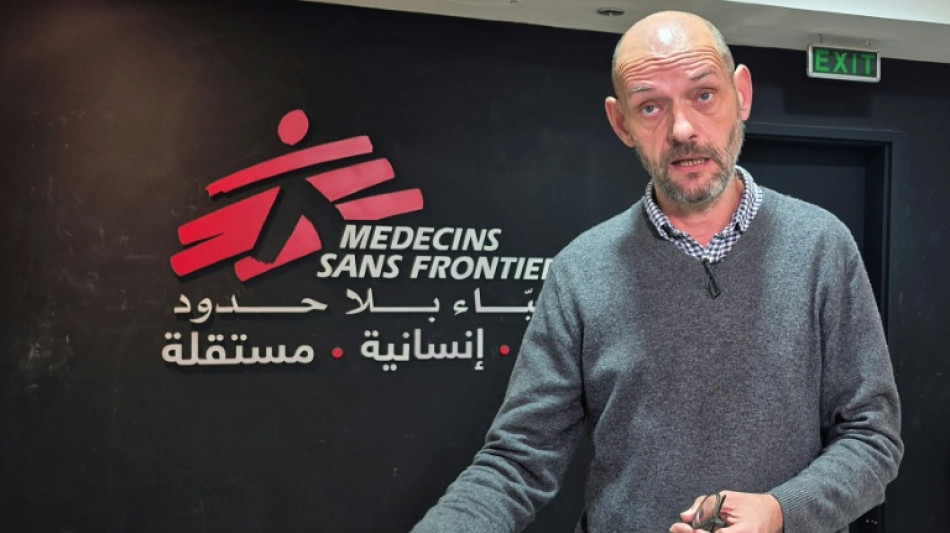
MSF will keep operating in Gaza 'as long as we can': mission head / Photo: Mussa HATTAR - AFP


 London
 10 °C
10 °C

 Manchester
 9 °C
9 °C
 Glasgow
10 °C
Glasgow
10 °C
 Dublin
11 °C
Dublin
11 °C
 Belfast
8 °C
Belfast
8 °C
 Washington
 15 °C
15 °C
 Denver
13 °C
Denver
13 °C
 Atlanta
 17 °C
17 °C
 Dallas
19 °C
Dallas
19 °C
 Houston Texas
23 °C
Houston Texas
23 °C
 New Orleans
20 °C
New Orleans
20 °C
 El Paso
18 °C
El Paso
18 °C
 Phoenix
24 °C
Phoenix
24 °C
 Los Angeles
18 °C
San Diego
18 °C
San Francisco
16 °C
Chicago
15 °C
Minneapolis
13 °C
Seattle
7 °C
Portland
9 °C
Salt Lake City
14 °C
Las Vegas
19 °C
Miami
26 °C
Jacksonville
22 °C
San Antonio
20 °C
Bermuda
28 °C
Nassau
13 °C
Iqaluit
-5 °C
Yellowknife
6 °C
Anchorage
Los Angeles
18 °C
San Diego
18 °C
San Francisco
16 °C
Chicago
15 °C
Minneapolis
13 °C
Seattle
7 °C
Portland
9 °C
Salt Lake City
14 °C
Las Vegas
19 °C
Miami
26 °C
Jacksonville
22 °C
San Antonio
20 °C
Bermuda
28 °C
Nassau
13 °C
Iqaluit
-5 °C
Yellowknife
6 °C
Anchorage
 0 °C
Fairbanks
-5 °C
Barrow
0 °C
Fairbanks
-5 °C
Barrow
 -6 °C
Calgary
3 °C
Edmonton
14 °C
Winnipeg
6 °C
Goose Bay
7 °C
Halifax
12 °C
Boston
10 °C
Ottawa
8 °C
Toronto
11 °C
Detroit
12 °C
Cleveland
13 °C
New York
13 °C
Baltimore
15 °C
Philadelphia
-6 °C
Calgary
3 °C
Edmonton
14 °C
Winnipeg
6 °C
Goose Bay
7 °C
Halifax
12 °C
Boston
10 °C
Ottawa
8 °C
Toronto
11 °C
Detroit
12 °C
Cleveland
13 °C
New York
13 °C
Baltimore
15 °C
Philadelphia
 13 °C
Nuuk (Godthåb)
-5 °C
Hong Kong
13 °C
Nuuk (Godthåb)
-5 °C
Hong Kong
 28 °C
Singapore
29 °C
Melbourne
23 °C
Canberra
12 °C
Adelaide
17 °C
Darwin
28 °C
Singapore
29 °C
Melbourne
23 °C
Canberra
12 °C
Adelaide
17 °C
Darwin
 29 °C
Perth
19 °C
Fort Worth
18 °C
Honolulu
24 °C
Sydney
29 °C
Perth
19 °C
Fort Worth
18 °C
Honolulu
24 °C
Sydney
 18 °C
Johannesburg
29 °C
Dubai
33 °C
Mumbai
33 °C
Zürich
10 °C
Tokyo
26 °C
Seoul
7 °C
Delhi
25 °C
Beijing
5 °C
Riyadh
34 °C
Prague
16 °C
Pennsylvania
13 °C
Valletta
25 °C
Manama
32 °C
Warsaw
15 °C
Stockholm
11 °C
18 °C
Johannesburg
29 °C
Dubai
33 °C
Mumbai
33 °C
Zürich
10 °C
Tokyo
26 °C
Seoul
7 °C
Delhi
25 °C
Beijing
5 °C
Riyadh
34 °C
Prague
16 °C
Pennsylvania
13 °C
Valletta
25 °C
Manama
32 °C
Warsaw
15 °C
Stockholm
11 °C
The head of Doctors Without Borders in the Palestinian territories told AFP the charity would continue working in Gaza for as long as possible, following an Israeli decision to end its activities there.
In early February, Israel announced it was terminating all the activities in Gaza by the medical charity, known by its French acronym MSF, after it failed to provide a list of its Palestinian staff.
MSF has slammed the move, which takes effect on March 1, as a "pretext" to obstruct aid.
"For the time being, we are still working in Gaza, and we plan to keep running our operations as long as we can," Filipe Ribeiro told AFP in Amman, but said operations were already facing challenges.
"We haven't been able to get international staff inside Gaza since the beginning of January. Israeli authorities denied any entry to Gaza, but also to the West Bank," he said.
He added that the current team of international staff, who like most international NGOs rotate in and out every few months, is due to leave in late February and will not be replaced if the current situation holds.
- Depleting medicine stocks -
Ribeiro added that MSF's ability to bring medical supplies into Gaza had also been impacted.
"They're not allowed for now, but we have some stocks in our pharmacies that will allow us to keep running operations for (the) time being," he said.
"We do have teams in Gaza that are still working, both national and international, and we have stocks."
Shortages of everything from fuel and food to medicine and clean water have been an ongoing issue in Gaza since the start of the war, with Israel imposing restrictions on all trucks entering the territory.
In December, Israel announced it would prevent 37 aid organisations, including MSF, from working in Gaza from March 1 for failing to submit detailed information about their Palestinian employees, drawing widespread condemnation from NGOs and the United Nations.
It had alleged that two MSF employees had links with Palestinian militant groups Hamas and Islamic Jihad, which the medical charity has repeatedly and vehemently denied.
"MSF has not hired any member of an armed group, and if there is, if there is such a case, then of course, MSF will act. We have put in place a screening system for people joining MSF," Ribeiro said.
"It's not perfect, but it's strict," he added.
MSF says it did not provide the names of its Palestinian staff because Israeli authorities offered no assurances regarding their safety.
In total, 15 Palestinian employees of the NGO were killed in Israeli strikes or by gunfire in Gaza since the war started on October 7, 2023.
"MSF is one of the biggest actors when it comes to the health provision in Gaza and the West Bank, and if we are obliged to leave, then we will create a huge void in Gaza," he said.
The charity says it currently provides at least 20 percent of hospital beds in the territory and operates around 20 health centres.
In 2025 alone, it carried out more than 800,000 medical consultations, treated more than 100,000 trauma cases and assisted more than 10,000 infant deliveries.
- Keeping hospitals neutral -
In January, MSF said it partly pulled out of Nasser Hospital, the largest medical facility in the southern Gaza Strip, due to an increasing presence of armed men on the compound, which runs against the organisation's rules.
"We decided to suspend operations and we are waiting for the Minister of Health and local authorities to take action," and ensure the hospital remains neutral ground, Ribeiro said.
When asked whether MSF's decision to suspend operations and raise the issue of armed men in the hospital had anything to do with Israel's termination of its operations, Ribeiro said: "No, it has nothing to do with the decision made by the Israelis."
"Actually, it has to do with our capacity to keep running our operations, to be able to provide medical care in a safe environment."
He said that MSF staff remained in the hospital's burns unit and orthopedic department, but suspended outpatient activities such as maternity and orthopaedic operations because the health ministry has the capacity to run those departments.
Despite the challenges, Ribeiro said MSF hopes to keep providing services in Gaza.
"We hope that we will find one way or the other to reopen a dialogue with the Israeli government in order to make sure that soon, and the sooner the better, we will be able to go back to Gaza."
msh-acc-jd-lba/acc/rh
O.Poirier--SMC