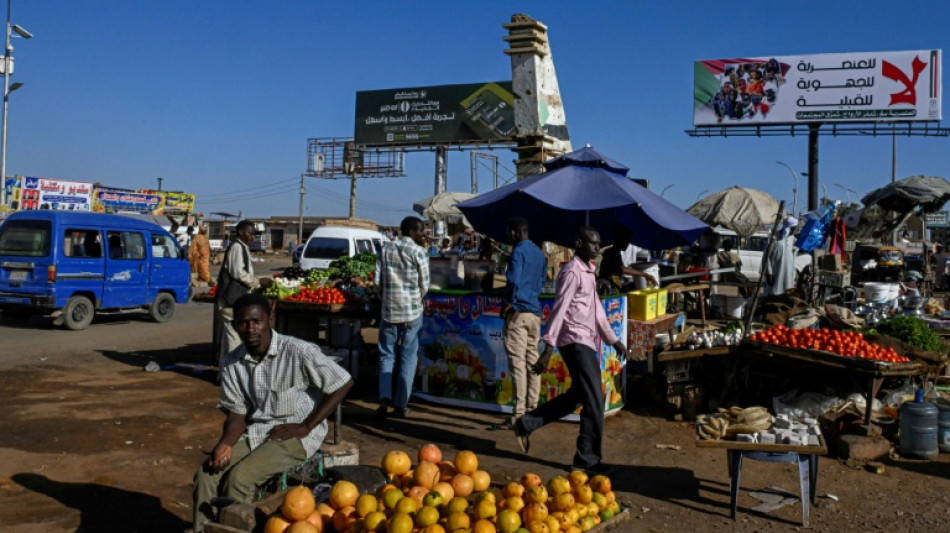
Drone attack kills 28 at market in southern Sudan / Photo: Khaled DESOUKI - AFP


 London
 9 °C
9 °C

 Manchester
 8 °C
8 °C
 Glasgow
 10 °C
10 °C
 Dublin
 4 °C
4 °C
 Belfast
 2 °C
2 °C
 Washington
6 °C
Washington
6 °C
 Denver
13 °C
Denver
13 °C
 Atlanta
9 °C
Atlanta
9 °C
 Dallas
12 °C
Dallas
12 °C
 Houston Texas
15 °C
Houston Texas
15 °C
 New Orleans
16 °C
New Orleans
16 °C
 El Paso
13 °C
El Paso
13 °C
 Phoenix
21 °C
Phoenix
21 °C
 Los Angeles
24 °C
San Diego
23 °C
San Francisco
16 °C
Chicago
8 °C
Minneapolis
10 °C
Seattle
10 °C
Portland
Los Angeles
24 °C
San Diego
23 °C
San Francisco
16 °C
Chicago
8 °C
Minneapolis
10 °C
Seattle
10 °C
Portland
 11 °C
Salt Lake City
12 °C
Las Vegas
20 °C
Miami
23 °C
Jacksonville
19 °C
San Antonio
12 °C
Bermuda
11 °C
Salt Lake City
12 °C
Las Vegas
20 °C
Miami
23 °C
Jacksonville
19 °C
San Antonio
12 °C
Bermuda
 26 °C
Nassau
6 °C
Iqaluit
-11 °C
Yellowknife
1 °C
Anchorage
4 °C
Fairbanks
-1 °C
Barrow
-3 °C
Calgary
9 °C
Edmonton
5 °C
Winnipeg
10 °C
Goose Bay
1 °C
Halifax
1 °C
Boston
1 °C
Ottawa
2 °C
Toronto
6 °C
Detroit
6 °C
Cleveland
3 °C
New York
6 °C
Baltimore
6 °C
Philadelphia
5 °C
Nuuk (Godthåb)
-2 °C
Hong Kong
26 °C
Nassau
6 °C
Iqaluit
-11 °C
Yellowknife
1 °C
Anchorage
4 °C
Fairbanks
-1 °C
Barrow
-3 °C
Calgary
9 °C
Edmonton
5 °C
Winnipeg
10 °C
Goose Bay
1 °C
Halifax
1 °C
Boston
1 °C
Ottawa
2 °C
Toronto
6 °C
Detroit
6 °C
Cleveland
3 °C
New York
6 °C
Baltimore
6 °C
Philadelphia
5 °C
Nuuk (Godthåb)
-2 °C
Hong Kong
 32 °C
Singapore
33 °C
Melbourne
24 °C
Canberra
20 °C
Adelaide
29 °C
Darwin
32 °C
Perth
19 °C
Fort Worth
10 °C
Honolulu
25 °C
Sydney
20 °C
Johannesburg
32 °C
Singapore
33 °C
Melbourne
24 °C
Canberra
20 °C
Adelaide
29 °C
Darwin
32 °C
Perth
19 °C
Fort Worth
10 °C
Honolulu
25 °C
Sydney
20 °C
Johannesburg
 22 °C
Dubai
34 °C
Mumbai
34 °C
Zürich
9 °C
Tokyo
24 °C
Seoul
20 °C
Delhi
29 °C
Beijing
18 °C
Riyadh
34 °C
Prague
9 °C
Pennsylvania
3 °C
Valletta
19 °C
Manama
37 °C
Warsaw
6 °C
Stockholm
4 °C
22 °C
Dubai
34 °C
Mumbai
34 °C
Zürich
9 °C
Tokyo
24 °C
Seoul
20 °C
Delhi
29 °C
Beijing
18 °C
Riyadh
34 °C
Prague
9 °C
Pennsylvania
3 °C
Valletta
19 °C
Manama
37 °C
Warsaw
6 °C
Stockholm
4 °C
A drone strike on a crowded market in southern Sudan killed 28 people and injured 23 more on Tuesday, a medical source and witnesses told AFP, in one of the deadliest recent attacks on civilians in the country's three-year war.
The strike hit the town of Ghubaysh in West Kordofan, an area controlled by the paramilitary Rapid Support Forces (RSF) whose conflict with the Sudanese military has devastated much of the country since April 2023.
The wounded and the dead were taken to the town's hospital, the medical source said.
Witnesses described a scene of sudden destruction at the town's main market.
Two said a drone struck a crowded restaurant, attributing the attack to the military.
Another described what appeared to be a two-stage attack: an initial strike on an RSF vehicle that killed three people, followed moments later by a second blast that hit the restaurant.
Emergency Lawyers, a Sudanese legal advocacy group, said the strike targeted a key market relied on by thousands of civilians for food and basic supplies.
A spokesman for the Sudanese military denied responsibility, saying the armed forces carry out strikes only against "military objectives", including vehicles and weapons depots.
An RSF-aligned alliance condemned the strike, accusing the military of a "systematic" campaign of targeting civilians and civilian infrastructure in violation of international law.
- Broadening battlefield -
Tuesday's attack comes as drone warfare has become an increasingly prominent feature of Sudan's conflict, with both sides deploying unmanned strikes across a broadening battlefield.
Between January and April, at least 880 civilians -- more than 80 percent of all conflict-related civilian deaths -- were killed in drone strikes, according to the United Nations.
Fighting has escalated in recent months in southern Kordofan and the southeastern state of Blue Nile, following the RSF's capture last October of El-Fasher, the military's last major stronghold in western Darfur.
The Kordofan region, home to oil deposits, arable land and the RSF's most powerful paramilitary allies, connects RSF strongholds in the neighbouring Darfur region to the country's army-controlled east.
The RSF controls West Kordofan and has for months pushed eastwards in an attempt to recapture Sudan's central corridor.
The army has pushed back, breaking paramilitary sieges on two key cities in South Kordofan and attempting to cut off the RSF's supply link with Darfur.
Now in its fourth year, the war has killed tens of thousands of people and forced more than 11 million from their homes, creating what the United Nations describes as one of the world's worst humanitarian crises.
At the same time, Sudan is facing the world's largest hunger crisis, with nearly 20 million people -- or two in five Sudanese -- experiencing acute food insecurity, according to the Integrated Food Security Phase Classification, a UN-backed monitor.
Last week, the UN warned that without urgent international action, the crisis could spiral into an "even greater tragedy".
Famine was declared last year in El-Fasher and in Kadugli, the capital of South Kordofan.
The IPC has warned that 14 areas across Darfur and South Kordofan are at risk of famine if fighting intensifies and access to food, health care and clean water continues to deteriorate or displacement increases.
Since October, more than 300,000 people have fled frontline areas, including El-Fasher and parts of Kordofan and Blue Nile, according to the UN, as the war grinds on with no clear resolution in sight.
S.Clark--SMC