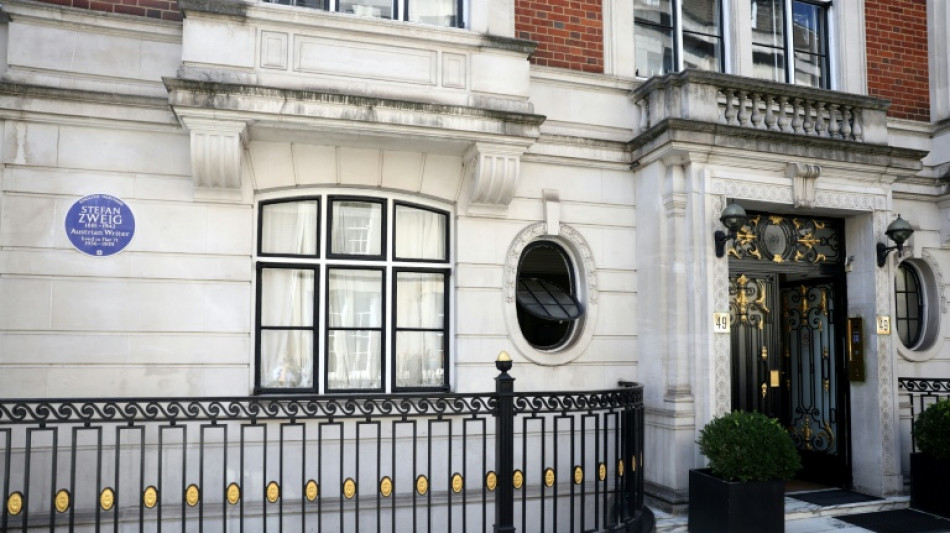
Austrian writer Stefan Zweig, who fled Nazis, honoured in London / Photo: Toby Shepheard - AFP


 London
 13 °C
13 °C

 Manchester
13 °C
Manchester
13 °C
 Glasgow
 3 °C
3 °C
 Dublin
15 °C
Dublin
15 °C
 Belfast
14 °C
Belfast
14 °C
 Washington
17 °C
Washington
17 °C
 Denver
 20 °C
20 °C
 Atlanta
16 °C
Atlanta
16 °C
 Dallas
24 °C
Dallas
24 °C
 Houston Texas
25 °C
Houston Texas
25 °C
 New Orleans
21 °C
New Orleans
21 °C
 El Paso
 23 °C
23 °C
 Phoenix
23 °C
Phoenix
23 °C
 Los Angeles
18 °C
San Diego
Los Angeles
18 °C
San Diego
 17 °C
San Francisco
12 °C
Chicago
18 °C
Minneapolis
24 °C
Seattle
8 °C
Portland
8 °C
Salt Lake City
11 °C
Las Vegas
20 °C
Miami
27 °C
Jacksonville
21 °C
San Antonio
24 °C
Bermuda
26 °C
Nassau
12 °C
Iqaluit
17 °C
San Francisco
12 °C
Chicago
18 °C
Minneapolis
24 °C
Seattle
8 °C
Portland
8 °C
Salt Lake City
11 °C
Las Vegas
20 °C
Miami
27 °C
Jacksonville
21 °C
San Antonio
24 °C
Bermuda
26 °C
Nassau
12 °C
Iqaluit
 -5 °C
Yellowknife
6 °C
Anchorage
6 °C
Fairbanks
-5 °C
Yellowknife
6 °C
Anchorage
6 °C
Fairbanks
 2 °C
Barrow
-1 °C
Calgary
-1 °C
Edmonton
14 °C
Winnipeg
6 °C
Goose Bay
12 °C
Halifax
13 °C
Boston
11 °C
Ottawa
13 °C
Toronto
14 °C
Detroit
16 °C
Cleveland
17 °C
New York
13 °C
Baltimore
16 °C
Philadelphia
13 °C
Nuuk (Godthåb)
0 °C
Hong Kong
30 °C
Singapore
33 °C
Melbourne
24 °C
Canberra
2 °C
Barrow
-1 °C
Calgary
-1 °C
Edmonton
14 °C
Winnipeg
6 °C
Goose Bay
12 °C
Halifax
13 °C
Boston
11 °C
Ottawa
13 °C
Toronto
14 °C
Detroit
16 °C
Cleveland
17 °C
New York
13 °C
Baltimore
16 °C
Philadelphia
13 °C
Nuuk (Godthåb)
0 °C
Hong Kong
30 °C
Singapore
33 °C
Melbourne
24 °C
Canberra
 23 °C
Adelaide
16 °C
Darwin
34 °C
Perth
23 °C
Adelaide
16 °C
Darwin
34 °C
Perth
 22 °C
Fort Worth
24 °C
Honolulu
25 °C
Sydney
32 °C
Johannesburg
19 °C
Dubai
35 °C
Mumbai
36 °C
Zürich
22 °C
Fort Worth
24 °C
Honolulu
25 °C
Sydney
32 °C
Johannesburg
19 °C
Dubai
35 °C
Mumbai
36 °C
Zürich
 7 °C
Tokyo
26 °C
Seoul
28 °C
Delhi
25 °C
Beijing
20 °C
Riyadh
33 °C
Prague
7 °C
Pennsylvania
14 °C
Valletta
23 °C
Manama
34 °C
Warsaw
7 °C
Stockholm
9 °C
7 °C
Tokyo
26 °C
Seoul
28 °C
Delhi
25 °C
Beijing
20 °C
Riyadh
33 °C
Prague
7 °C
Pennsylvania
14 °C
Valletta
23 °C
Manama
34 °C
Warsaw
7 °C
Stockholm
9 °C
With its grand facade, the 1930s London mansion block looks like countless others. But one flat hides a tale of one of the darkest chapters in 20th century European history.
Famed Austrian writer Stefan Zweig lived in flat number 71, at 49, Hallam Street, for three years until 1939 after fleeing his homeland as Nazi leader Adolf Hitler began his rise to power
Largely forgotten by modern readers, Zweig -- the inspiration for Wes Anderson's 2014 film "The Grand Budapest Hotel" -- was a major literary figure who during his lifetime was the world's most widely translated author.
In the event of an invasion of Britain, the writer would have been among the highest profile targets of the Nazi's so-called "black book".
SS units would have been directed to Hallam Street to detain and "neutralise" Zweig.
The address was included in the secret Sonderfahndungsliste G.B. ("Special Search List Great Britain") which contained the names of around 2,820 politicians, writers, scientists, refugees, journalists and others considered enemies of the Nazi regime.
Ninety years after Zweig settled in Hallam Street, UK admirers including the late playwright Tom Stoppard and novelist Julian Barnes, have finally won their bid to have the address officially commemorated.
A round blue plaque, recently mounted on the block's exterior, now alerts passers-by to the building's famous former resident.
- Freud eulogy -
"Stefan Zweig 1881-1942, Austrian Writer lived in flat 71, 1936-1939," reads the marker erected as part of the English Heritage's Blue Plaques programme.
The scheme, which has been running since 1866, aims to honour the link between notable figures and UK buildings where they lived and worked.
Blue Plaques historian Susan Skedd said Zweig's mental state appeared to fluctuate during his time in the capital, where he also lived at several other addresses.
"His letters say how much comfort he gets from London, but the fact that the Brits are generally unbothered by the war -- that infuriates him," she said.
Gathering material for his autobiography "The World of Yesterday" also caused him to dwell on the lost world of his past life in Vienna, she said. He left the city in 1933.
"He feels that civilisation is lost ... which is profoundly sad," she added.
In September 1939, as war in Europe broke out, Zweig delivered the funeral eulogy for fellow exile, psychoanalyst Sigmund Freud, at London's Golders Green Cemetery.
- Cultural loss -
According to English Heritage, 30 other blue plaque recipients appeared on the Nazis' list, but Zweig's Hallam Street flat was one of only two locations to be explicitly given, the other being the home of English science fiction author H. G. Wells.
Zweig's works included "Letter from an Unknown Woman" (1922) and "Twenty-Four Hours in the Life of a Woman" (1927), which were translated into dozens of languages.
His later novel "Beware of Pity" (1939) was written and published during the time he lived in Hallam Street.
Anderson said in a video message to mark the blue plaque that he had "never heard" of Zweig until he chanced upon a copy of "Beware of Pity", prompting him to immediately seek out another of his works, "The Post Office Girl", published posthumously in 1982.
"I sort of stole elements from both these books for 'The Grand Budapest Hotel'," he said, adding that Ralph Fiennes' character in the film was largely modelled on Zweig.
Although he did find refuge in London, there was to be no happy ending for Zweig whose later works drew on his own experiences of displacement and cultural loss.
He left for New York in 1940, and later set up home in Brazil. The worsening situation in Europe, however, left him profoundly depressed.
On February 23, 1942, the day after finishing his autobiography, Zweig, then aged 60, and his second wife Lotte, 33, each took a fatal dose of barbiturates.
har/jkb/db
K.Morrison--SMC