
BULGOLD Discovers the Kopernica Vein System Within the North East Block on the Lutila Gold Project


 London
 21 °C
21 °C

 Manchester
20 °C
Manchester
20 °C
 Glasgow
15 °C
Glasgow
15 °C
 Dublin
19 °C
Dublin
19 °C
 Belfast
16 °C
Belfast
16 °C
 Washington
14 °C
Washington
14 °C
 Denver
15 °C
Denver
15 °C
 Atlanta
17 °C
Atlanta
17 °C
 Dallas
26 °C
Dallas
26 °C
 Houston Texas
 28 °C
28 °C
 New Orleans
 26 °C
26 °C
 El Paso
 18 °C
18 °C
 Phoenix
27 °C
Phoenix
27 °C
 Los Angeles
20 °C
San Diego
20 °C
San Francisco
15 °C
Chicago
17 °C
Minneapolis
14 °C
Seattle
11 °C
Portland
10 °C
Salt Lake City
13 °C
Las Vegas
22 °C
Miami
27 °C
Jacksonville
22 °C
San Antonio
26 °C
Bermuda
26 °C
Nassau
14 °C
Iqaluit
5 °C
Yellowknife
8 °C
Anchorage
Los Angeles
20 °C
San Diego
20 °C
San Francisco
15 °C
Chicago
17 °C
Minneapolis
14 °C
Seattle
11 °C
Portland
10 °C
Salt Lake City
13 °C
Las Vegas
22 °C
Miami
27 °C
Jacksonville
22 °C
San Antonio
26 °C
Bermuda
26 °C
Nassau
14 °C
Iqaluit
5 °C
Yellowknife
8 °C
Anchorage
 4 °C
Fairbanks
-1 °C
Barrow
-3 °C
Calgary
7 °C
Edmonton
19 °C
Winnipeg
14 °C
Goose Bay
12 °C
Halifax
16 °C
Boston
15 °C
Ottawa
14 °C
Toronto
16 °C
Detroit
16 °C
Cleveland
14 °C
New York
14 °C
Baltimore
14 °C
Philadelphia
14 °C
Nuuk (Godthåb)
3 °C
Hong Kong
4 °C
Fairbanks
-1 °C
Barrow
-3 °C
Calgary
7 °C
Edmonton
19 °C
Winnipeg
14 °C
Goose Bay
12 °C
Halifax
16 °C
Boston
15 °C
Ottawa
14 °C
Toronto
16 °C
Detroit
16 °C
Cleveland
14 °C
New York
14 °C
Baltimore
14 °C
Philadelphia
14 °C
Nuuk (Godthåb)
3 °C
Hong Kong
 28 °C
Singapore
29 °C
Melbourne
27 °C
Canberra
28 °C
Singapore
29 °C
Melbourne
27 °C
Canberra
 12 °C
Adelaide
20 °C
Darwin
12 °C
Adelaide
20 °C
Darwin
 27 °C
Perth
15 °C
Fort Worth
26 °C
Honolulu
25 °C
Sydney
17 °C
Johannesburg
27 °C
Dubai
36 °C
Mumbai
30 °C
Zürich
27 °C
Perth
15 °C
Fort Worth
26 °C
Honolulu
25 °C
Sydney
17 °C
Johannesburg
27 °C
Dubai
36 °C
Mumbai
30 °C
Zürich
 20 °C
Tokyo
25 °C
Seoul
21 °C
Delhi
33 °C
Beijing
19 °C
Riyadh
41 °C
Prague
15 °C
Pennsylvania
12 °C
Valletta
27 °C
Manama
39 °C
Warsaw
14 °C
Stockholm
16 °C
20 °C
Tokyo
25 °C
Seoul
21 °C
Delhi
33 °C
Beijing
19 °C
Riyadh
41 °C
Prague
15 °C
Pennsylvania
12 °C
Valletta
27 °C
Manama
39 °C
Warsaw
14 °C
Stockholm
16 °C
TORONTO, ON / ACCESS Newswire / February 10, 2026 / BULGOLD Inc. (TSXV:ZLTO) (the "Company" or "BULGOLD") is pleased to announce that it has received all outstanding assay data relating to the 2025 exploration programme on the Lutila Gold Project (the "Property"). This information has now been reviewed, validated and incorporated into the Company's database. The Lutila exploration licence covers an area of 32.2km2 and is prospective for quartz-adularia epithermal gold mineralisation.
1. Highlights
The Company has recently identified the Kopernica Vein System, which has been mapped, drilled and sampled across an area measuring 1,000 metres by 500 metres on the western slopes of the North East Block.
The Kopernica Vein System is focused on the 700-metre long Main Vein, where surface float samples of hydrothermally brecciated rock and epithermal quartz vein material at the 550mRL have results of up to 2.88 grammes per tonne (g/t) of gold (Au) and 15.8 g/t of silver (Ag).
Surface mapping has identified several subvertical hanging wall splay veins connected to the Main Vein, which can be intermittently traced for about 600 meters to the north. In this area, a hydrothermal breccia outcrop in a small creek returned 0.55g/t Au.
The Company identified the West Vein late in the season, outlining an initial 300 metres of strike length and results up to 1.19g/t Au and 4.3g/t Ag from an epithermal quartz vein boulder at surface.
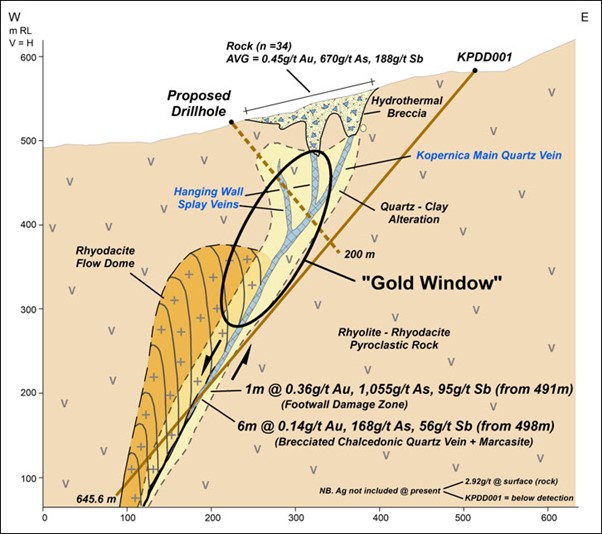
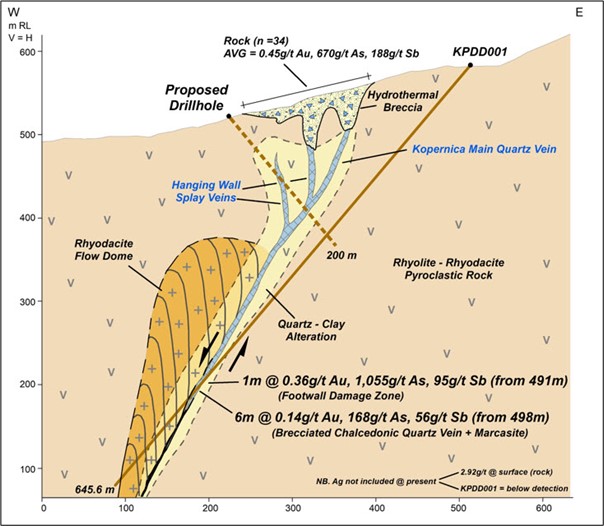
The BULGOLD exploration team initially believed that the Main Vein was subvertical; however, this is not the case. The vein-structure was encountered during the drilling of KPDD001 at a considerable depth of 498 metres downhole, where an intersection of 6m @ 0.14 g/t Au was recorded within a brecciated chalcedonic quartz vein containing marcasite at the 200mRL.
Surface mapping, drilling and rock sampling indicate that the Main Vein's "gold window" spans a 250-300 metre vertical range between the 550mRL (average surface rock sample: 0.45g/t Au, 2.9g/t Ag, 670g/t As, 188g/t Sb) and the KPDD001 drill intercept at 200mRL.
Future drilling at the Main Vein is planned to use drillholes no longer than 250 metres in length, significantly reducing exploration costs.
Drilling at the Horna Klapa target area, located within the Sinter Field, was completed to a target depth of 541.7 metres and failed to intersect any evidence of quartz veining within an upflow zone or evidence for rhyolite dyke activity beneath the ridgeline.
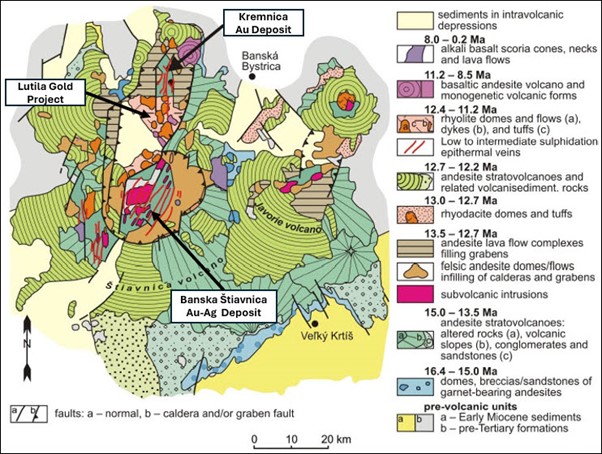
The Lutila Gold Project is located favourably between two of the largest Au-Ag epithermal vein systems within the Central Slovak Volcanic Field, the Kremnica gold deposit and the Banska Štiavnica gold-silver ore field, which, collectively, have produced significant amounts of precious metals over many centuries.
Exploration target: underground, high-grade gold (Au) ± silver (Ag) quartz veins.
Quote from the President & CEO, Mr. Sean Hasson:
"Over 1,000 years of exploration and mining of epithermal vein systems in Central Slovakia demonstrates that, to date, every discovered vein system has contained either gold or silver. The identification of the Kopernica Vein System establishes the Company as a leading candidate for growth and discovery within the prevailing gold market.
Last year's exploration programme has surpassed expectations by allowing us to delineate the Kopernica Vein System over an initial area of 1,000 metres by 500 metres through surface sampling, mapping, and the first drillhole into the 700-metre long Main Vein. There remains substantial exploration potential within this newly identified vein system which is evidenced by the presence of potential hanging wall splay veins to the Main Vein and the West Vein which is an emerging parallel quartz vein located 200 metres to the west.
KPDD001 was the first hole drilled into the Main Vein, and it intersected the vein deeper than the BULGOLD exploration team initially expected, due to its overall westerly dip. However, this allowed us to determine the geometry of the vein system and establish that the "gold window" likely spans a vertical range of 250-300 metres. This means that the upcoming drillholes designed to confirm the gold potential of the Main Vein can be less than 250 meters deep, saving both time and money, together with the added benefit that the drillhole will also intersect any hanging wall splay veins en route to the Main Vein target.
At the nearby historic epithermal quartz vein deposits of Kremnica and the Kremnica Vein II system, mining operations were conducted over an approximately 400 metre and 200-350 metre vertical window respectively; this effectively shows what the "gold window" potential can be within this part of the Central Slovakia. The "gold window" concept highlights that because epithermal vein systems are not uniformly mineralised, precisely identifying these transient, specific conditions is essential for successful exploration (see Figure 1 on the following page for a graphical representation of the "gold window" concept as applied to the Kopernica Vein System).
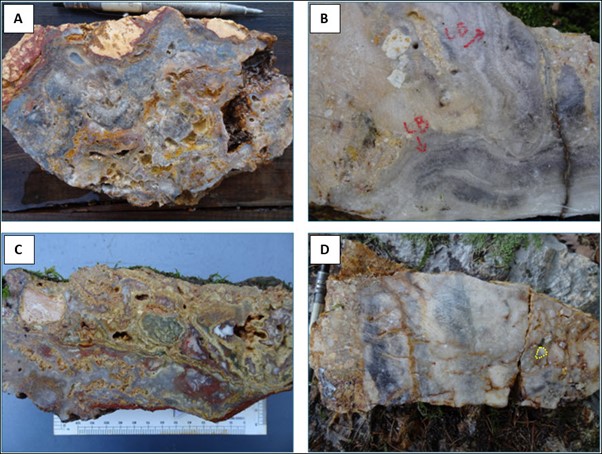
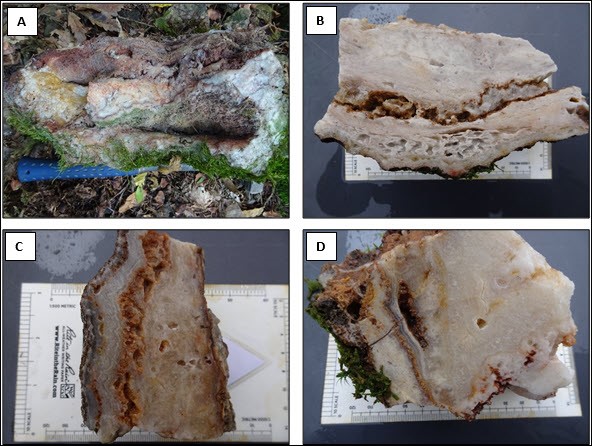
Surface rocks are typically composed of hydrothermal breccias, often containing fragments of epithermal quartz veins dislodged from deeper sections of the vein system. In adjacent areas at slightly lower elevations, there is a notable presence of quartz vein boulders and rocks exhibiting well-developed crustiform-colloform textures. The extensive degree of brecciation observed in the surface rocks indicates that the Kopernica Vein System may possess the conditions necessary for a high fluid-flux hydrothermal environment, which generally results from frequent and violent boiling events. In epithermal quartz-adularia vein systems, such boiling processes are widely regarded as the most effective mechanism for the formation of bonanza-grade gold veins.
"Since we started exploration drilling on the Lutila Gold Project 18 months ago we have remained steadfast in adhering to our internal target ranking methodology and efficient allocation of capital. The first targets to be tested were located under Rhyolite Ridge within the Sinter Field, however having now drilled three drillholes for no reward it was clear that a trend was emerging. As such, the Company does not plan to drill any more holes within the Sinter Field in the short to medium term. The current exploration model within the Sinter Field will need to be reassessed by the Company.
The Company exercised its option to acquire the Lutila Gold Project and assumed 100% control of the project 28 months ago. The following day, management met with the Mayor of Lutila to discuss exploration plans and establish connections. Since then, we have continued building lasting relationships in the region, adapting to local operating conditions and regulations, and contributing to the local economy.
The Company is actively assessing various strategies to advance the discovery process on the Lutila Gold Project."
2. The Kopernica Vein System - Exploration
The western slopes of the North East Block were the focus for the BULGOLD exploration team during the latter half of 2025. A few historic rock chips from this area had previously returned low levels of gold e.g. 0.47g/t Au, 0.22g/t Au and 0.12g/t Au with arsenic and antimony geochemical support from "brecciated saccharoidal quartz boulders". The BULGOLD due diligence field visit during 2022 also confirmed the presence and grade of these historic samples but recognised that the textures within these samples were, in fact, weakly developed crustiform-colloform chalcedonic quartz veins.
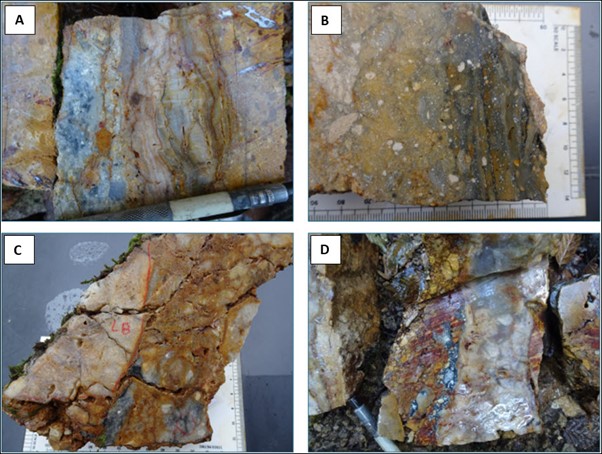
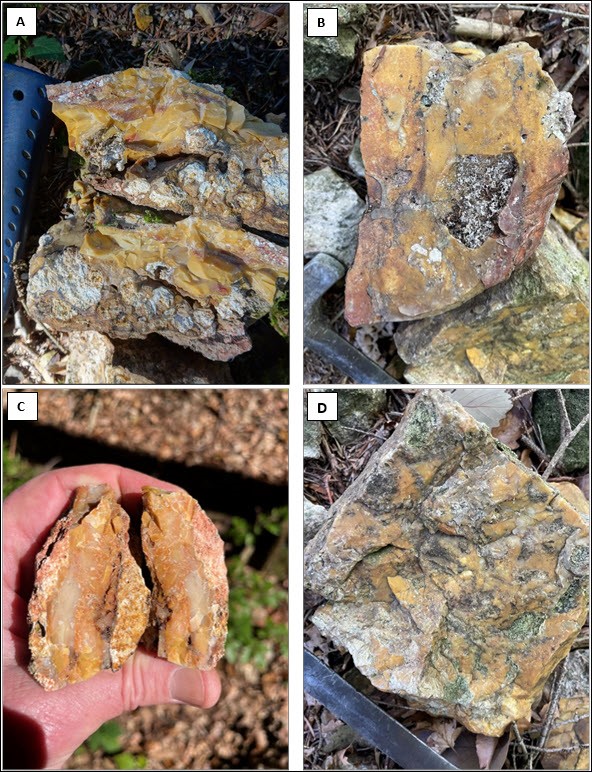
The objective of the late 2025 exploration programme was to establish where these chalcedonic quartz boulders had originated. The approach taken by the BULGOLD exploration team was to undertake a series of geological traverses commencing at the highest point of the ridgeline and then effectively walking along the contours and then dropping down to the next contour and repeating the exercise. All surface rock float (± outcrop) material was assessed during these traverses which led to the development of the mapping and prospecting framework that is shown in Table 1, and which has become an integral part of the BULGOLD exploration 'toolkit' when exploring the North East Block for epithermal quartz veins. Figure 1 shows the distribution of hydrothermally altered rocks across the Kopernica Vein System according to this framework.
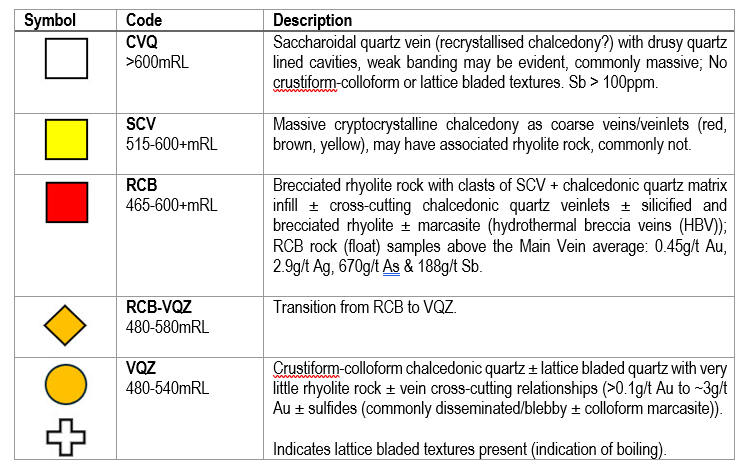
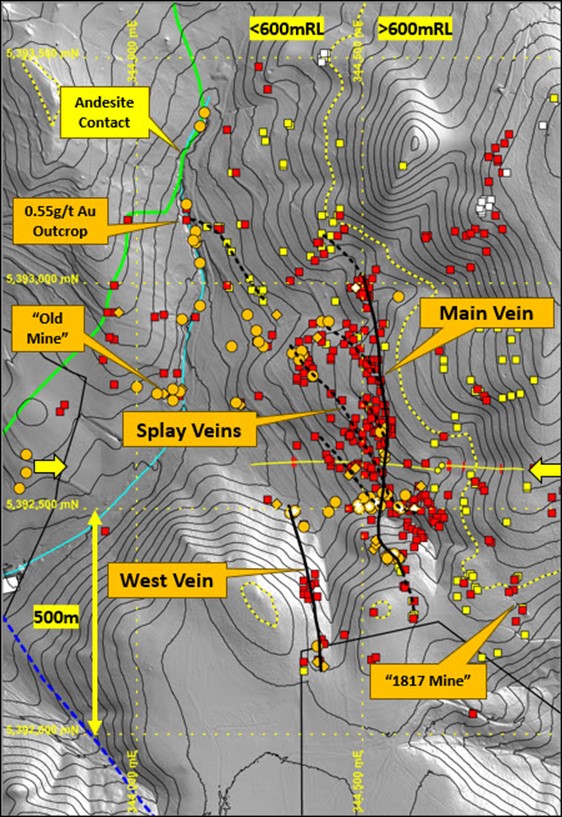
By employing this methodical approach, the BULGOLD exploration team was able to establish the existence of the Kopernica Vein System which is centred on the 700-metre long Main Vein. There remains substantial exploration potential within this newly identified vein system which is evidenced by the presence of potential hanging wall splay veins to the Main Vein and the West Vein which is an emerging parallel quartz vein located 200 metres to the west.
Previous assessment of all rock and drill core, both historic and BULGOLD, within the North East Block has established that gold in rock commences below the 600mRL. The Kopernica Vein System is no exception from this finding and is defined on surface between the 590mRL to the 490mRL.
Additionally, approximately 600m to the north-west of the Main Vein an outcrop of hydrothermal breccia was identified in a small creek which assayed 0.55g/t Au and 200g/t Sb. Abundant hydrothermally altered float rock has been identified within this area directly beneath the andesite rock contact that continues north to host the Kremnica gold deposit. More exploration is required in this area to determine the potential for additional quartz veins.
Historic mining activity appears to be restricted to two areas, both located on the periphery of the currently defined Kopernica Vein System: 1) The "1817 Mine" (underground operation) which is located 400 metres south-east of the Main Vein and just below the 600mRL and strikes north-west towards the Main Vein and 2) The "Old Mine" (small open pit) which is located 500 metres west north-west of the Main Vein at the confluence of two drainages at the 490mRL. Within the area above the Main Vein there appears to be what may be interpreted as 'exploration test pits', likely assessing the gold potential of the hydrothermal breccia ± epithermal quartz vein pieces found at surface; their age remains unknown.
The extensive degree of brecciation observed in the surface rocks, particularly above the Main Vein, indicates that the Kopernica Vein System may possess the conditions necessary for a high fluid-flux hydrothermal environment, which generally results from frequent and violent boiling events. In epithermal quartz-adularia vein systems, such boiling processes are widely regarded as the most effective mechanism for the formation of bonanza-grade gold veins.
Table 2 shows all the BULGOLD surface rock samples ≥0.1g/t Au that have been collected within the currently defined Kopernica Vein System.
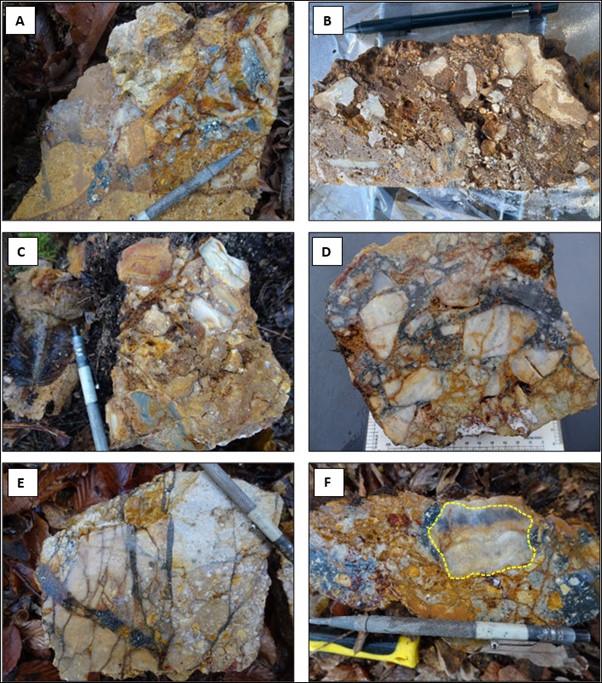
Figures 3, 4, 5, 6 and 7 show images of the surface float rock that have contributed to the BULGOLD mapping and prospecting framework with a particular focus on the Kopernica Vein System.
SAMPLEID | X_UTM34N | Y_UTM34N | Z_UTM34N | Au_BEST_ppm | Ag_BEST_ppm | As_BEST_ppm | Sb_BEST_ppm |
95805 | 344476 | 5392591 | 543 | 2.88 | 15.8 | 439 | 207 |
95933 | 344550 | 5392680 | 576 | 2.03 | 9.3 | 74.4 | 71 |
95941 | 344340 | 5392490 | 510 | 1.19 | 4.3 | 70.6 | 128 |
95937 | 344520 | 5392590 | 554 | 1.18 | 4.8 | 1877 | 40 |
95806 | 344551 | 5392712 | 581 | 1.11 | 1 | 109 | 134 |
95714 | 344563 | 5392677 | 579 | 1.03 | 1 | 193 | 104 |
95936 | 344550 | 5392620 | 567 | 0.83 | 8.7 | 261 | 95.5 |
45503 | 344503 | 5392524 | 536 | 0.81 | 5 | 74.8 | 26.6 |
45045 | 344520 | 5392500 | 536 | 0.81 | 5.42 | 49.8 | 10.1 |
45047 | 344540 | 5392507 | 540 | 0.76 | 6.78 | 151.2 | 14.1 |
95934 | 344545 | 5392690 | 576 | 0.72 | 4.1 | 113 | 140 |
95935 | 344545 | 5392670 | 570 | 0.67 | 3.7 | 212 | 167 |
95931 | 344545 | 5392535 | 545 | 0.63 | 4 | 20 | 19 |
45048 | 344580 | 5392505 | 553 | 0.62 | 2.53 | 437.8 | 61.2 |
45504 | 344490 | 5392509 | 532 | 0.58 | 5.9 | 38.5 | 44 |
95929 | 344110 | 5393140 | 505 | 0.55 | 1 | 39.3 | 200 |
95902 | 344540 | 5392670 | 572 | 0.54 | 2.9 | 200 | 195 |
95715 | 344538 | 5392696 | 575 | 0.49 | 1 | 184 | 125 |
95901 | 344600 | 5392600 | 573 | 0.46 | 1 | 1304 | 319 |
95808 | 344472 | 5392663 | 550 | 0.44 | 1 | 217 | 144 |
95807 | 344525 | 5392668 | 568 | 0.37 | 2 | 142 | 189 |
45046 | 344530 | 5392515 | 539 | 0.34 | 1.7 | 73.8 | 10.7 |
95932 | 344555 | 5392680 | 578 | 0.33 | 1 | 88.8 | 99.1 |
45502 | 344515 | 5392505 | 536 | 0.33 | 2.5 | 115 | 39.8 |
95910 | 344555 | 5392385 | 574 | 0.29 | 1 | 193 | 86.7 |
95809 | 344485 | 5392596 | 546 | 0.27 | 1 | 458 | 193 |
95942 | 344350 | 5392495 | 510 | 0.27 | 1 | 49.9 | 131 |
95912 | 344570 | 5392390 | 578 | 0.26 | 1 | 338 | 173 |
95915 | 344505 | 5393000 | 579 | 0.25 | 1 | 922 | 204 |
45501 | 344517 | 5392525 | 539 | 0.25 | 1 | 367 | 177 |
95911 | 344560 | 5392390 | 575 | 0.24 | 1 | 449 | 165 |
45505 | 344493 | 5392500 | 531 | 0.19 | 1 | 138 | 94.5 |
95904 | 344470 | 5392500 | 527 | 0.19 | 17.3 | 661 | 144 |
95930 | 344585 | 5392390 | 581 | 0.18 | 1 | 822 | 185 |
95913 | 344570 | 5392400 | 576 | 0.18 | 1 | 463 | 124 |
95938 | 344370 | 5392310 | 572 | 0.17 | 5.1 | 3264 | 367 |
45506 | 344425 | 5392493 | 521 | 0.13 | 1 | 205 | 44.2 |
95926 | 344360 | 5392870 | 542 | 0.11 | 1 | 355 | 210 |
95940 | 344385 | 5392330 | 559 | 0.1 | 4.4 | 3633 | 464 |
Table 2. Kopernica Vein System: All BULGOLD surface rock samples ≥0.1g/t Au (n=39).
3. The Kopernica Vein System - Drilling
KPDD001 was drilled to test the Main Vein within the North East Block:
HOLEID | X_UTM34N | Y_UTM34N | Z_UTM34N | AZIMUTH | DIP | DEPTH (m) |
KPDD001 | 344667 | 5392585 | 574 | 280 | -48.9 | 645.6 |
Table 3. KPDD001 exploration drill hole information.
Gold anomalous intervals from KPDD001, targeting the Main Vein are outlined below:
1m @ 0.36g/t Au, 1,055g/t As, 95g/t Sb (from 491m) *
Footwall damage zone.
6m @ 0.14g/t Au, 168g/t As, 56g/t Sb (from 498m) *
Brecciated chalcedonic quartz vein + marcasite.
*1m minimum composite length, no internal dilution, 0.1g/t Au cut-off; the Company considers this to represent a 'geological cut-off' which shows that gold is present in the Main Vein at strongly anomalous values. True widths are unknown at this stage. Overall drill core recovery was 97.7%.
Geologically, KPDD001 intersected the following volcanic units:
0-65m: Rhyolite pyroclastic rock with minor zones of hydrothermal brecciation.
65-229m: Rhyodacite (feldspar-biotite phyric) pyroclastic rock with minor chalcedony-marcasite veinlets; weak argillic to propylitic alteration.
229-498m: Rhyodacite flow aligned pyroclastic unit with disseminated marcasite from 380m; weak to strong argillic alteration.
498-504m: Brecciated chalcedonic quartz vein with disseminated marcasite.
504-638m: Rhyolite to rhyodacite flow banded unit; this unit is the hanging wall to the Main Vein at depth; strong quartz-sericite (illite?) ± hematite alteration affecting both the (glassy) groundmass and the phenocryst phases (plagioclase, biotite, amphibole ± monoclinic pyroxene); occasional quartz veinlets (≤2cm) cross-cut the flow dome unit from ~540m to ~600m downhole and are associated with low grade gold (average: 0.05g/t Au) and strongly anomalous arsenic and antimony (average: 263g/t As, 171g/t Sb); after 600m downhole the alteration assemblage becomes quartz-sericite-carbonate.
638-645.6m: Volcanic breccia (epiclastic) unit; sericite-carbonate alteration.
KPDD001 was the first hole drilled into the Main Vein, and it intersected the vein deeper than the BULGOLD exploration team initially expected, due to its overall westerly dip. However, this allowed us to determine the geometry of the vein system and establish that the 'gold window' likely spans a vertical range of 250-300 meters. This means that the upcoming drillholes designed to confirm the gold potential of the Main Vein can be less than 250 meters deep, saving both time and money, together with the added benefit that the drillhole will also intersect any hanging wall splay veins en route to the Main Vein target (see Figure 8).
4. Horna Klapa - Drilling
HKDD001 was drilled to test the Horna Klapa target area within the Sinter Field:
HOLEID | X_UTM34N | Y_UTM34N | Z_UTM34N | AZIMUTH | DIP | DEPTH (m) |
HKDD001 | 343717 | 5390838 | 597 | 305 | -49.2 | 541.7 |
Table 4. HKDD001 exploration drill hole information.
Geologically, HKDD001 intersected the following volcanic units:
0-30m: Pyroclastic rock unit; block and ash flow with layered tuff bands; weak argillic alteration.
30-47m: Flow banded rhyolite unit.
47-128m: Flow banded rhyolite unit; a combination of volcanic breccia and lavas.
128m-144m: Pyroclastic unit; strong argillic alteration (bentonite).
144-303m: Rhyolite breccia unit; a combination of poorly consolidated epiclastic material and spherulitic lava to lava breccias; weak argillic alteration.
303-369.5m: Block and ash pyroclastic flow unit; essentially monomict quartz-biotite ± feldspar.
369.5-541.7m: Pyroclastic flow unit, polymict rhyolite clasts (red, white & black ± flow banding) with minor fine tuff/epiclastic layers.
Overall drill core recovery was 96.6%.
Drilling at the Horna Klapa target area, located within the Sinter Field, was completed to a target depth of 541.7 metres and failed to intersect any evidence of quartz veining within an upflow zone or evidence for rhyolite dyke activity beneath the ridgeline.
5. Discussion
The Lutila Gold Project is located favourably between two of the largest Au-Ag epithermal vein systems within the Central Slovak Volcanic Field, the Kremnica gold deposit and the Banska Štiavnica gold-silver ore field, which collectively, have produced significant amounts of precious metals over many centuries.
The Property is located 5km south, along strike and within the same volcanic depression that hosts the historic quartz-adularia Kremnica gold mine (current JORC (2012) mineral resource estimate of M&I: 36.9Mt @ 1.36g/t Au (1.6Moz Au) and Inf: 31.5Mt @ 1.07g/t Au (1.1Moz Au))1 Historic gold production is estimated by Finka (1995) to be 1.48Moz.
[1]This is not a mineral reserve or mineral resource that has been prepared in compliance with the requirements of National Instrument 43-101. The technical and scientific information disclosed from neighboring properties does not necessarily apply to the Lutila Gold Project. The current JORC (2012) mineral resource estimate for the Kremnica gold mine consists of: Measured 24.6Mt @ 1.46g/t Au, Indicated 12.3Mt @ 1.15g/t Au and Inferred 31.5Mt @ 1.07g/t Au. Source: Metals Tech Limited, ASX Release, 8th May 2023 (https://wcsecure.weblink.com.au/pdf/MTC/02663482.pdf).
The Kremnica Vein II system which is located in the hanging wall position to the Kremnica gold deposit (and under the town of Kremnica) has similar dimensions to the currently defined Kopernica Vein System, being approximately 1,000 metres by 500 metres and consisted of more than 40 individual veins which were generally north-south striking and dipping to both the east and west. Interestingly, historic records suggest that the thickness of these veins decreased with depth. The highest gold values were recorded from within ore shoots and according to Bakoš et al (2017) from 1938 until mine closure in 1970, 18t @ 2.5% Au was mined. The vein system was discovered serendipitously during underground development and mining started at the end of the 18th century.
According to Kodera (2005) the Banska Štiavnica ore field has produced 2.6Moz Au and 129Moz Ag from the early middle ages until the twentieth century.
The fact that low to intermediate sulfidation Au-Ag epithermal vein systems are intimately associated with rhyolite volcanism during the period 12.4 - 11.2Ma underpins the Company's exploration model (See Figure 8).
The newly discovered Kopernica Vein System, located within the North East Block, should facilitate the Company's exploration process on the Lutila Gold Project in that we have discovered the rocks that we have been looking for on surface and above the underlying vein system. The following attributes make the further exploration of this vein system compelling:
The Kopernica Vein System is focused on the 700-metre long Main Vein, where surface float samples of hydrothermally brecciated rock and epithermal quartz vein material at the 550mRL have results of up to 2.88 g/t Au and 15.8 g/t Ag.
Surface mapping has identified several subvertical hanging wall splay veins connected to the Main Vein, which can be intermittently traced for about 600 metres to the north. In this area, a hydrothermal breccia outcrop in a small creek returned 0.55g/t Au.
The Company identified the West Vein late in the season, outlining an initial 300 metres of strike length and results up to 1.19g/t Au and 4.3g/t Ag from an epithermal quartz vein boulder at surface.
The BULGOLD exploration team initially believed that the Main Vein was subvertical; however, this is not the case. The vein-structure was encountered during the drilling of KPDD001 at a considerable depth of 498 metres downhole, where an intersection of 6m @ 0.14 g/t Au was recorded within a brecciated chalcedonic quartz vein containing marcasite at the 200mRL.
Surface mapping, drilling and rock sampling indicate that the Main Vein's gold potential spans a 250-300 metre vertical range between the 550mRL (average surface rock sample: 0.45g/t Au, 2.9g/t Ag, 670g/t As, 188g/t Sb) and the KPDD001 drill intercept at 200mRL.
Future drilling at the Main Vein plans to use drillholes no longer than 250 metres in length, significantly reducing exploration costs.
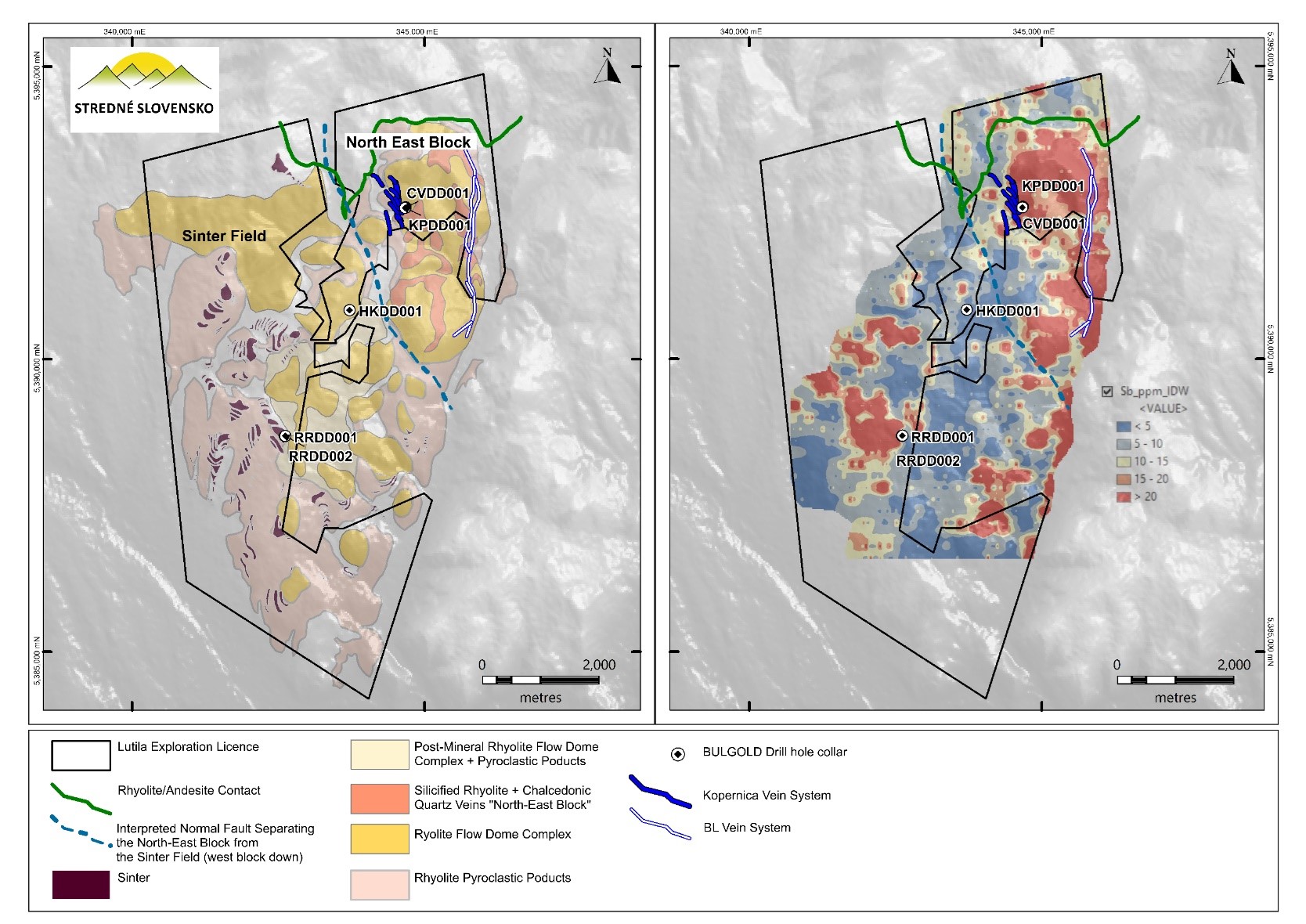
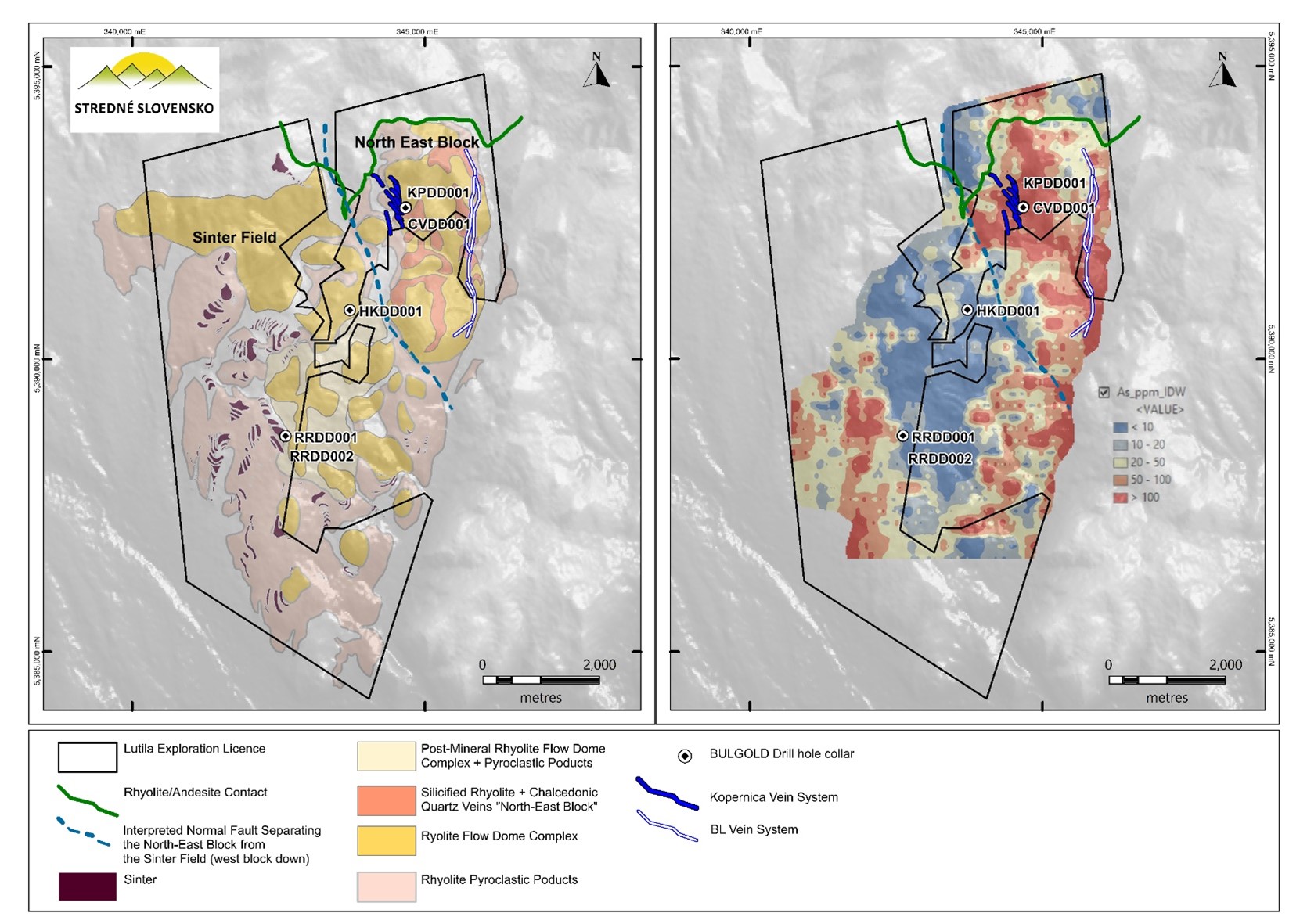
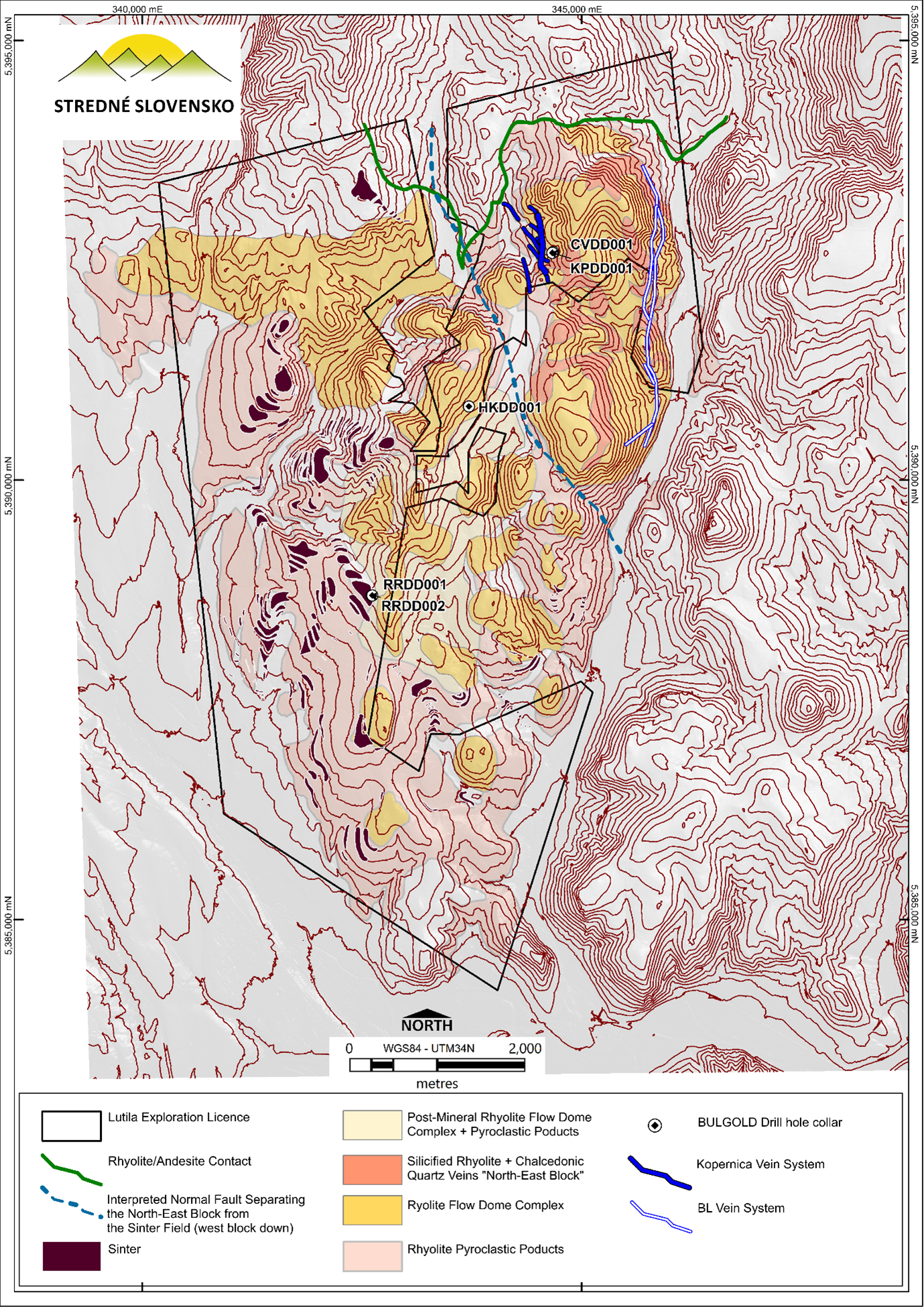
Historic soil sampling has outlined a significant, +7km long, paleo-geothermal system as defined by arsenic and antimony geochemistry (see Figures 10 & 11). Historic and the Company's rock chip sampling, which is biased to the North East Block, has shown that surface gold grades increase in value toward lower elevations, which is in line with the Company's current geological model. Historic exploration drilling, which is also restricted to the North East Block, has shown that there are strongly anomalous gold grades within the rhyolite flow dome complexes and their pyroclastic products on either flank of the North East Block which is centred on the Čertov vrch peak (748mRL), see Figure 12.
Historic rock chip sampling, which is limited to the North East Block, has shown that surface gold grades increase in value (up to 4.44g/t Au) towards lower elevations; Bartošova Lehôtka (BL) Vein System.
Historic exploration drilling, which is also restricted to the North East Block, recorded a best intersection of 26.2m @ 0.91g/t Au (from 97m) from the Bartošova Lehôtka (BL) Vein System.
The reader is encouraged to review the Company's press release relating to historic exploration activity, primarily relating to the North East Block: May 1, 2024 "BULGOLD Highlights the Potential Scale of the Lutila Gold Project Through a Review of Historic Exploration Data"
The Company believes that the Lutila Gold Project reflects a continuation of the same volcanic depression (that hosts the Kremnica gold mine), which has been downfaulted, creating a preserved graben of rhyolite flow domes complexes and their pyroclastic products together with a very large sinter field.
About the Slovak Republic
Drill pads can be permitted within 3-months.
EU and NATO member since 2004.
Eurozone (€)member since 2009.
Established mining industry, clearly defined mining legislation.
No restrictions on foreign ownership.
21% corporate tax rate.
5% NSR for gold and silver.
The use of cyanide for extractive purposes has been prohibited since 2014.
Low-cost profiles, skilled local workforce.
Exploration licences can be held for a 10-year period (4+4+2).
References:
Bakoš F., Chovan M., Žitňan P. et al, 2017. Gold in Slovakia, Vydavatel'stvo LÚČ, Bratislava, 2017 (in Slovak and English).
Finka, O., 1995. Zlatá Kremnica: Tisícročná história baníctva, Neografia vydavateľstvo, Monografie 71 pages (in Slovak).
Kodera P., Lexa J., Rankin AH., Fallick AE., 2005. Epithermal gold veins in a caldera setting: Banská Hodruša, Slovakia. Mineralium Deposita. 39: 921-943
Kodera P., Lexa J., Fallick AE., Walle M., Biron A., 2014. Hydrothermal fluids in epithermal and porphyry Au deposits in the Central Slovakia Volcanic Field. Geological Society, London, Special Publications 2014, v.402; p177-206.
About BULGOLD Inc.
BULGOLD is a gold exploration company focused on the exploration and development of mineral exploration projects in Central and Eastern Europe. The Company controls 100% of three quality quartz-adularia epithermal gold projects located in the Slovakian and Bulgarian portions of the Western Tethyan Belt: the Lutila Gold Project, the Kostilkovo Gold Project and the Kutel Gold Project. Management of the Company believes that its assets show potential for high-grade, good-metallurgy, low-sulfidation epithermal gold mineralisation.
On December 31, 2025, BULGOLD's issued and outstanding shares were 49,132,335 of which approximately 28.3% were held by Founders, Directors and Management.
Additional information about the Company is available on BULGOLD's website (www.BULGOLD.com) and on SEDAR+ (www.sedarplus.ca).
Historic Sampling and Drilling Data and Information
The historical sampling and drilling data and information disclosed in this news release is related to historical exploration results. The reader is cautioned that the historical sampling and drilling data and information are based on prior data and reports previously prepared by third parties without the involvement of the Company. Information has been sourced from the Slovak Geological Survey in reports 83971 (December 1997) and 92416 (February 2013).BULGOLD has not undertaken any independent investigation of the historical sampling and drilling data and information, nor has it independently analyzed the results of the historical sampling and drilling exploration work in order to verify the results. The reader is cautioned not to treat them, or any part of them, as current due to the fact that a qualified person has not done sufficient work to verify the results and that they may not form a reliable guide to future results. No independent quality assurance/quality control protocols are known for these historic samples and drill holes and therefore the analytical results, data and information may be unreliable. BULGOLD considers the historical sample and drill data and information to be relevant as BULGOLD is using this data and information, in conjunction with the sampling conducted by BULGOLD, as a guide to plan its exploration program for the Lutila Gold Project. BULGOLD's current exploration work includes verification of the historical data and information through further exploration.
Sampling, Analysis and QAQC of Exploration Drill Core Samples
Most exploration diamond drill holes are collared with PQ size, continued with HQ, and are sometimes finished with NQ. Triple tube core barrels and short runs are used whenever possible to improve recovery. All drill core is cut lengthwise into two halves using a diamond saw; the right-hand half looking downhole is sampled for assaying and the other half is retained in core trays. The common length for sample intervals within mineralized zones is one metre. Weights of drill core samples range from three to eight kilograms ("kg"), depending on the size of core, rock type, and recovery. A numbered tag is placed into each sample bag, and the samples are grouped into batches for laboratory submissions.
Diamond drill core and rock samples are shipped to SGS Burgas, Bulgaria. Quality control samples, comprising certified reference materials, blanks, and field duplicates, are inserted into each batch of samples and locations for crushed duplicates and pulp replicates are specified. All drill core and quality control samples are tabulated on sample submission forms that specify sample preparation procedures and codes for analytical methods. For internal quality control, the laboratory includes its own quality control samples comprising certified reference materials, blanks and pulp duplicates. All QAQC monitoring data are reviewed, verified and signed off by the Company. Chain of custody records are maintained from sample shipments to the laboratory until analyses are completed and remaining sample materials are returned to the Company. The chain of custody is transferred from the Company to SGS at the laboratory door.
At the SGS Burgas laboratory, the submitted core samples are dried at 105°C for a minimum of 12 hours and then jaw crushed to ~80% passing 2-6mm. Sample preparation duplicates are created by riffle splitting crushed samples on a 1-in-20 basis. Larger samples are riffle split prior to pulverizing, whereas smaller samples are pulverized entirely. Pulverizing specifications are 90% passing 75 microns. Gold analyses are done using a conventional 50-gram fire assay and AAS finish. Multi-element analyses for 32 elements are done using a four-acid digestion and an ICP-OES finish.
Qualified Person
The scientific and technical information in this news release was reviewed and approved by Mr Sean Hasson, a Qualified Person as defined by National Instrument 43-101 and President and Chief Executive Officer to the Company.
Neither TSX Venture Exchange nor its Regulation Services Provider (as that term is defined in the policies of the TSX Venture Exchange) accepts responsibility for the adequacy or accuracy of this release.
Cautionary Statement Regarding Forward-Looking Information
This press release contains forward‐looking statements and forward‐looking information within the meaning of applicable securities laws (collectively, "forward-looking statements"). These statements relate to future events or future performance and include statements relating to the exploration and drilling plans of the Company and the timing thereof; future drillhole lengths at the Kopernica Vein System and the anticipated cost savings; the exploration potential within the Kopernica Vein System; the potential for the Kopernica Vein System to possess conditions necessary for bonanza-grade gold veins; the gold window likely spanning a vertical range of 250-300 meters; the Company's decision not to drill additional holes within the Sinter Field in the short to medium term; the identification of the Kopernica Vein System establishing the Company as a leading candidate for growth and discovery; the Company's assessment of various strategies to advance the discovery process on the Lutila Gold Project; the Lutila Gold Project as prospective for quartz-adularia epithermal gold mineralisation; the Lutila Gold Project reflecting a continuation of the same volcanic depression that hosts the Kremnica gold mine; the Company's exploration model for the Lutila Gold Project; and the potential of the Lutila Gold Project to benefit the Company's stakeholders. All statements other than statements of historical fact may be forward‐looking statements or information. The forward‐looking statements and information are based on certain key expectations and assumptions made by management of the Company. Although management of the Company believes that the expectations and assumptions on which such forward-looking statements and information are based are reasonable, undue reliance should not be placed on the forward‐looking statements and information since no assurance can be given that they will prove to be correct.
Forward-looking statements and information are provided for the purpose of providing information about the current expectations and plans of management of the Company relating to the future. Readers are cautioned that reliance on such statements and information may not be appropriate for other purposes, such as making investment decisions. Since forward‐looking statements and information address future events and conditions, by their very nature they involve inherent risks and uncertainties. Actual results could differ materially from those currently anticipated due to a number of factors and risks, including the inherent uncertainty of mineral exploration; the risk that the Kopernica Vein System does not contain economic quantities of gold or silver; the risk that drilling results may not confirm surface sampling results or geological interpretations; risks related to the accuracy of the Company's geological model and assumptions regarding vein geometry and the vertical extent of mineralisation; the risk that future drilling may not intersect mineralisation or may intersect mineralisation at grades lower than anticipated; risks related to title to mineral properties; and changes in laws or regulations, including environmental laws and regulations; and credit, market, currency, operational, commodity, geopolitical, liquidity and funding risks generally, including changes in economic conditions, interest rates or tax rates and general market conditions. Accordingly, readers should not place undue reliance on the forward‐looking statements and information contained in this press release. Readers are cautioned that the foregoing list of factors is not exhaustive. The forward‐looking statements and information contained in this press release are made as of the date hereof and no undertaking is given to update publicly or revise any forward‐looking statements or information, whether as a result of new information, future events or otherwise, unless so required by applicable securities laws. The forward-looking statements and information contained in this press release are expressly qualified by this cautionary statement.
For further information, please contact:
BULGOLD Inc.
Sean Hasson, President and Chief Executive Officer
Telephone: +359 887 560 545
Email: [email protected]
Website: www.BULGOLD.com
SOURCE: BULGOLD Inc.
X.Boucher--SMC