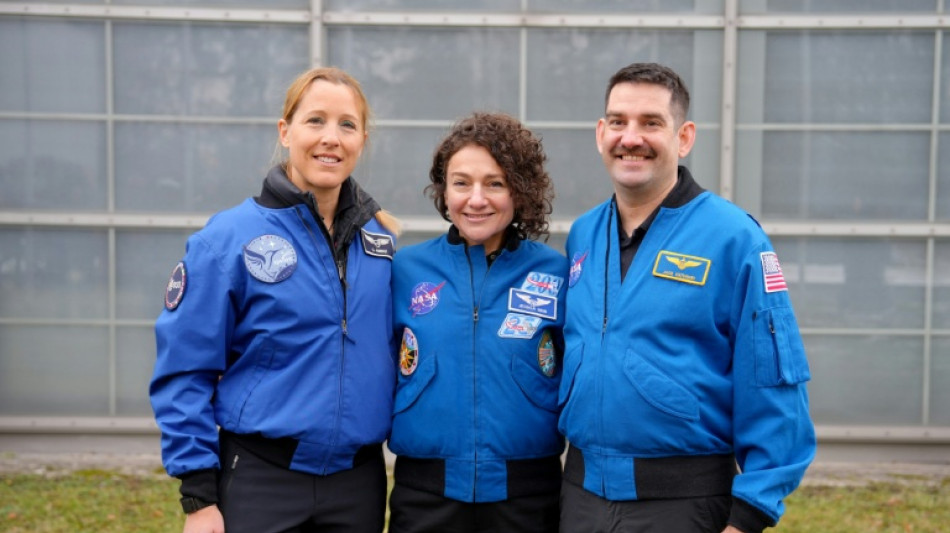
New crew set to launch for ISS after medical evacuation / Photo: Pau Barrena - AFP/File


 London
 11 °C
11 °C

 Manchester
 12 °C
12 °C
 Glasgow
12 °C
Glasgow
12 °C
 Dublin
16 °C
Dublin
16 °C
 Belfast
15 °C
Belfast
15 °C
 Washington
24 °C
Washington
24 °C
 Denver
16 °C
Denver
16 °C
 Atlanta
24 °C
Atlanta
24 °C
 Dallas
27 °C
Dallas
27 °C
 Houston Texas
29 °C
Houston Texas
29 °C
 New Orleans
 28 °C
28 °C
 El Paso
28 °C
El Paso
28 °C
 Phoenix
33 °C
Phoenix
33 °C
 Los Angeles
20 °C
San Diego
21 °C
San Francisco
14 °C
Chicago
17 °C
Minneapolis
13 °C
Seattle
15 °C
Portland
19 °C
Salt Lake City
16 °C
Las Vegas
Los Angeles
20 °C
San Diego
21 °C
San Francisco
14 °C
Chicago
17 °C
Minneapolis
13 °C
Seattle
15 °C
Portland
19 °C
Salt Lake City
16 °C
Las Vegas
 29 °C
Miami
29 °C
Miami
 25 °C
Jacksonville
24 °C
San Antonio
27 °C
Bermuda
27 °C
Nassau
20 °C
Iqaluit
2 °C
Yellowknife
13 °C
Anchorage
10 °C
Fairbanks
9 °C
Barrow
25 °C
Jacksonville
24 °C
San Antonio
27 °C
Bermuda
27 °C
Nassau
20 °C
Iqaluit
2 °C
Yellowknife
13 °C
Anchorage
10 °C
Fairbanks
9 °C
Barrow
 -1 °C
Calgary
14 °C
Edmonton
24 °C
Winnipeg
11 °C
Goose Bay
12 °C
Halifax
16 °C
Boston
16 °C
Ottawa
14 °C
Toronto
15 °C
Detroit
16 °C
Cleveland
18 °C
New York
20 °C
Baltimore
23 °C
Philadelphia
21 °C
Nuuk (Godthåb)
2 °C
Hong Kong
-1 °C
Calgary
14 °C
Edmonton
24 °C
Winnipeg
11 °C
Goose Bay
12 °C
Halifax
16 °C
Boston
16 °C
Ottawa
14 °C
Toronto
15 °C
Detroit
16 °C
Cleveland
18 °C
New York
20 °C
Baltimore
23 °C
Philadelphia
21 °C
Nuuk (Godthåb)
2 °C
Hong Kong
 31 °C
Singapore
31 °C
Singapore
 32 °C
Melbourne
25 °C
Canberra
21 °C
Adelaide
16 °C
Darwin
30 °C
Perth
21 °C
Fort Worth
26 °C
Honolulu
32 °C
Melbourne
25 °C
Canberra
21 °C
Adelaide
16 °C
Darwin
30 °C
Perth
21 °C
Fort Worth
26 °C
Honolulu
 26 °C
Sydney
21 °C
Johannesburg
12 °C
Dubai
31 °C
Mumbai
29 °C
Zürich
14 °C
Tokyo
26 °C
Sydney
21 °C
Johannesburg
12 °C
Dubai
31 °C
Mumbai
29 °C
Zürich
14 °C
Tokyo
 22 °C
Seoul
28 °C
Delhi
29 °C
Beijing
27 °C
Riyadh
28 °C
Prague
10 °C
Pennsylvania
19 °C
Valletta
24 °C
Manama
32 °C
Warsaw
11 °C
Stockholm
11 °C
22 °C
Seoul
28 °C
Delhi
29 °C
Beijing
27 °C
Riyadh
28 °C
Prague
10 °C
Pennsylvania
19 °C
Valletta
24 °C
Manama
32 °C
Warsaw
11 °C
Stockholm
11 °C
Four astronauts could blast off to the International Space Station (ISS) next week, after setbacks including a mysterious medical evacuation of the previous crew, last-minute rocket problems, and some scheduling conflicts with NASA's Moon mission.
The crew was scheduled to launch on February 11, Elon Musk's SpaceX company said this week it was grounding all flights on its Falcon 9 rocket while it investigates an unspecified issue.
This late uncertainty is just the most recent twist for the SpaceX Crew-12 mission, which includes Americans Jessica Meir and Jack Hathaway, French astronaut Sophie Adenot and Russian cosmonaut Andrey Fedyaev.
They will be replacing Crew-11, which returned to Earth in January, a month earlier than planned, during the first medical evacuation in the space station's history.
NASA has declined to disclose any details about the health issue that cut the mission short.
However, the scientific laboratory, which orbits 400 kilometres above Earth, has since been staffed by a skeleton crew of three.
Because of the medical evacuation, NASA moved the date of the Crew-12 launch forward a few days.
The launch had also overlapped with NASA's first mission to fly astronauts around the Moon in more than half a century.
The launch window for the Artemis 2 mission had been set for February 6-11 -- until leaks detected this week during final tests pushed the date back to March 6.
- 'One day, that will be me' -
Once the astronauts finally get on board, they will be one of the last crews to live on board the football field-sized space station.
Continuously inhabited for the last quarter century, the ageing ISS is scheduled to be pushed into Earth's orbit before crashing into an isolated spot in the Pacific Ocean in 2030.
The ISS, once a symbol of warming post-Cold War relations, has been a rare area of continued cooperation between the West and Russia since Moscow invaded Ukraine in 2022.
However, the space station has not entirely avoided the tensions back on Earth.
In November, Russian cosmonaut Oleg Artemyev -- who had long been planned to be a member of Crew-12 -- was suddenly taken off the mission.
Reports from independent media in Russia suggested he had been photographing and sending classified information with his phone. Russian space agency Roscosmos merely said he had been transferred to a different job.
His replacement Fedyaev, has already spent some time on the ISS as part of Crew-6 in 2023.
During their eight months on the space station, the four astronauts will conduct many experiments, including research into the effects of microgravity on their bodies.
Meir, who previously worked as a marine biologist studying animals in extreme environments, will serve as the crew's commander.
Adenot will become the second French woman to fly to space, following in the footsteps of Claudie Haignere, who spent time on the Mir space station.
When Adenot saw Haignere's mission blast off, she was 14 years old.
"It was a revelation," the helicopter pilot said recently.
"At that moment, I told myself: one day, that will be me."
Among other research, the European Space Agency astronaut will test a system that uses artificial intelligence and augmented reality to allow astronauts to carry out their own medical ultrasounds.
The mission is scheduled to launch from Cape Canaveral, Florida at 1100 GMT on February 11. If called off, launches can also be attempted on the following two days.
L.Côte--SMC