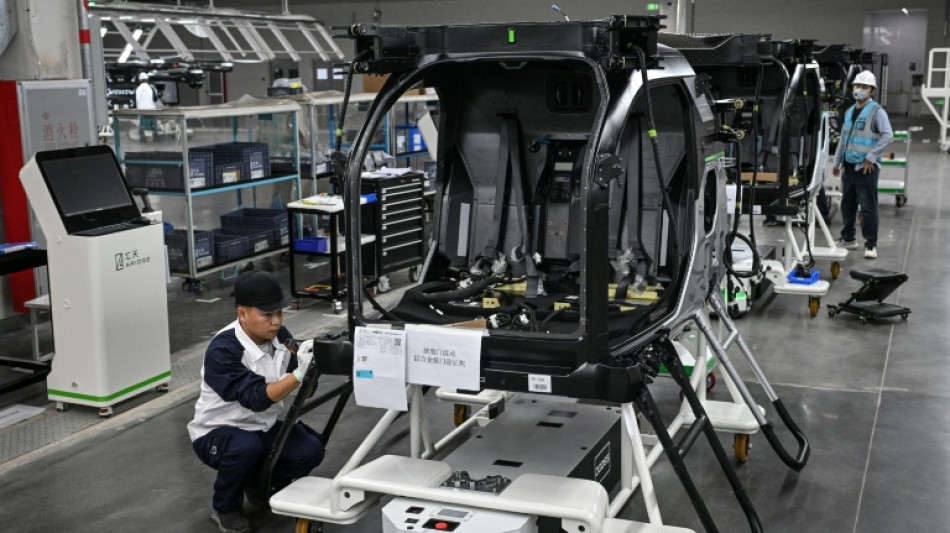
On rare earth supply, Trump for once seeks allies / Photo: Jade GAO - AFP/File


 London
 10 °C
10 °C
 Manchester
7 °C
Manchester
7 °C
 Glasgow
9 °C
Glasgow
9 °C
 Dublin
7 °C
Dublin
7 °C
 Belfast
5 °C
Belfast
5 °C
 Washington
 9 °C
9 °C
 Denver
18 °C
Denver
18 °C
 Atlanta
14 °C
Atlanta
14 °C
 Dallas
19 °C
Dallas
19 °C
 Houston Texas
21 °C
Houston Texas
21 °C
 New Orleans
16 °C
New Orleans
16 °C
 El Paso
 25 °C
25 °C
 Phoenix
26 °C
Phoenix
26 °C
 Los Angeles
 18 °C
San Diego
18 °C
San Diego
 20 °C
San Francisco
16 °C
Chicago
15 °C
Minneapolis
13 °C
Seattle
11 °C
Portland
14 °C
Salt Lake City
15 °C
Las Vegas
24 °C
Miami
24 °C
Jacksonville
16 °C
San Antonio
19 °C
Bermuda
25 °C
Nassau
12 °C
Iqaluit
-7 °C
Yellowknife
4 °C
Anchorage
20 °C
San Francisco
16 °C
Chicago
15 °C
Minneapolis
13 °C
Seattle
11 °C
Portland
14 °C
Salt Lake City
15 °C
Las Vegas
24 °C
Miami
24 °C
Jacksonville
16 °C
San Antonio
19 °C
Bermuda
25 °C
Nassau
12 °C
Iqaluit
-7 °C
Yellowknife
4 °C
Anchorage
 -1 °C
Fairbanks
-1 °C
Fairbanks
 -4 °C
Barrow
-8 °C
Calgary
8 °C
Edmonton
10 °C
Winnipeg
6 °C
Goose Bay
3 °C
Halifax
11 °C
Boston
9 °C
Ottawa
4 °C
Toronto
9 °C
Detroit
7 °C
Cleveland
6 °C
New York
12 °C
Baltimore
10 °C
Philadelphia
10 °C
Nuuk (Godthåb)
-6 °C
Hong Kong
-4 °C
Barrow
-8 °C
Calgary
8 °C
Edmonton
10 °C
Winnipeg
6 °C
Goose Bay
3 °C
Halifax
11 °C
Boston
9 °C
Ottawa
4 °C
Toronto
9 °C
Detroit
7 °C
Cleveland
6 °C
New York
12 °C
Baltimore
10 °C
Philadelphia
10 °C
Nuuk (Godthåb)
-6 °C
Hong Kong
 29 °C
Singapore
31 °C
Melbourne
23 °C
Canberra
22 °C
Adelaide
32 °C
Darwin
29 °C
Singapore
31 °C
Melbourne
23 °C
Canberra
22 °C
Adelaide
32 °C
Darwin
 32 °C
Perth
20 °C
Fort Worth
20 °C
Honolulu
26 °C
Sydney
22 °C
Johannesburg
32 °C
Perth
20 °C
Fort Worth
20 °C
Honolulu
26 °C
Sydney
22 °C
Johannesburg
 17 °C
Dubai
31 °C
Mumbai
33 °C
Zürich
6 °C
Tokyo
23 °C
Seoul
13 °C
Delhi
24 °C
Beijing
15 °C
Riyadh
27 °C
Prague
9 °C
Pennsylvania
6 °C
Valletta
19 °C
Manama
31 °C
Warsaw
13 °C
Stockholm
12 °C
17 °C
Dubai
31 °C
Mumbai
33 °C
Zürich
6 °C
Tokyo
23 °C
Seoul
13 °C
Delhi
24 °C
Beijing
15 °C
Riyadh
27 °C
Prague
9 °C
Pennsylvania
6 °C
Valletta
19 °C
Manama
31 °C
Warsaw
13 °C
Stockholm
12 °C
In his year since returning to office, President Donald Trump has shown disdain for longstanding alliances, vowing "America First" even if US friends lose out.
But on Wednesday, his administration will attempt the closest it has come to traditional alliance diplomacy, leading a meeting of more than 50 countries on ensuring a stable supply of critical minerals.
The trigger is simple -- China. The Asian power, seen by the United States as its long-term rival, has secured a dominant role over critical minerals, including rare earths vital to modern technologies from smartphones to electric cars to fighter jets.
China, flexing muscle in a trade war launched by Trump, last year tightened its supply chain for rare earths, sending shivers through the global economy.
China -- which mines some 60 percent of the world's rare earths and processes around 90 percent -- offered the United States a one-year reprieve in a deal with Trump in October.
The United States has aggressively reached agreements on critical minerals with allies including Japan -- which this week said it found potential in the first deep-sea search for rare earths -- as well as Australia, Saudi Arabia, South Korea and Thailand.
Interior Secretary Doug Burgum said that another 11 countries will join Wednesday and that another 20 are interested in participating in what he called a "global coalition," a phrase rarely uttered by the Trump administration.
"The concept there is that we would have tariff-free trade and exchanges amongst those countries around these critical and rare-earth minerals," Burgum said Tuesday at the Center for Strategic and International Studies.
Burgum said that the emerging bloc could go against free-market principles that the United States has historically espoused by regulating a minimum price for certain key minerals.
"If you have someone who's dominant who can flood a market with a particular material, they have the ability to essentially destroy the economic value of a company or a country's production," he said, in a veiled reference to China.
- Go it alone, usually -
Vice President JD Vance and Secretary of State Marco Rubio will lead the one-day ministerial meeting at the State Department.
Among senior officials in attendance will be the top diplomat of India -- which is especially concerned about Chinese industrial dominance, and moved recently to patch up with Trump after a rift -- as well as the foreign ministers of Italy, a go-to European partner for Trump, and Israel, which is eager for any US-led initiatives that would integrate it further in its region.
Trump since returning to office has vowed to use US might to secure wealth only for itself, even flirting with invading Greenland, an autonomous territory of NATO ally Denmark.
Trump will still seek US dominance on minerals.
On Monday he unveiled "Project Vault," which aims to stockpile critical minerals and effectively anything else needed by US industry.
"We're not just doing certain minerals and rare earths. We're doing everything," Trump said of the project, mentioning also magnets vital to car manufacturing.
The project will be driven by a $10 billion loan from the Export-Import Bank of the United States and $1.7 billion in private capital, a White House official said.
The European Union, which has seen persistent friction with Trump, hopes to seek a formal agreement on rare earths with the United States.
"We have to make sure that we're not bidding each other up for the same supplies," an EU official said.
US-led cooperation on critical minerals is not new.
Former president Joe Biden's administration in 2022 launched the Minerals Security Partnership, which expanded to two dozen countries including key US allies.
The initiative looked at collaborative funding, with the Export-Import Bank under Biden proposing a $500 million loan for a rare-earths mine and processing plant in Australia.
X.Baker--SMC