Germany's far-right AfD celebrates another state election win / Photo: RALF HIRSCHBERGER - AFP


 London
 18 °C
18 °C

 Manchester
 15 °C
15 °C
 Glasgow
 15 °C
15 °C
 Dublin
17 °C
Dublin
17 °C
 Belfast
16 °C
Belfast
16 °C
 Washington
 28 °C
28 °C
 Denver
20 °C
Denver
20 °C
 Atlanta
 31 °C
31 °C
 Dallas
36 °C
Dallas
36 °C
 Houston Texas
34 °C
Houston Texas
34 °C
 New Orleans
32 °C
New Orleans
32 °C
 El Paso
28 °C
El Paso
28 °C
 Phoenix
34 °C
Phoenix
34 °C
 Los Angeles
23 °C
San Diego
24 °C
San Francisco
14 °C
Chicago
Los Angeles
23 °C
San Diego
24 °C
San Francisco
14 °C
Chicago
 19 °C
Minneapolis
16 °C
Seattle
16 °C
Portland
14 °C
Salt Lake City
20 °C
Las Vegas
31 °C
Miami
31 °C
Jacksonville
29 °C
San Antonio
33 °C
Bermuda
29 °C
Nassau
19 °C
Iqaluit
7 °C
Yellowknife
14 °C
Anchorage
7 °C
Fairbanks
7 °C
Barrow
-1 °C
Calgary
21 °C
Edmonton
34 °C
Winnipeg
13 °C
Goose Bay
17 °C
Halifax
17 °C
Boston
16 °C
Ottawa
19 °C
Toronto
20 °C
Detroit
15 °C
Cleveland
20 °C
New York
20 °C
Baltimore
28 °C
Philadelphia
23 °C
Nuuk (Godthåb)
5 °C
Hong Kong
19 °C
Minneapolis
16 °C
Seattle
16 °C
Portland
14 °C
Salt Lake City
20 °C
Las Vegas
31 °C
Miami
31 °C
Jacksonville
29 °C
San Antonio
33 °C
Bermuda
29 °C
Nassau
19 °C
Iqaluit
7 °C
Yellowknife
14 °C
Anchorage
7 °C
Fairbanks
7 °C
Barrow
-1 °C
Calgary
21 °C
Edmonton
34 °C
Winnipeg
13 °C
Goose Bay
17 °C
Halifax
17 °C
Boston
16 °C
Ottawa
19 °C
Toronto
20 °C
Detroit
15 °C
Cleveland
20 °C
New York
20 °C
Baltimore
28 °C
Philadelphia
23 °C
Nuuk (Godthåb)
5 °C
Hong Kong
 28 °C
Singapore
28 °C
Singapore
 29 °C
Melbourne
29 °C
Canberra
15 °C
Adelaide
12 °C
Darwin
24 °C
Perth
13 °C
Fort Worth
33 °C
Honolulu
26 °C
Sydney
19 °C
Johannesburg
17 °C
Dubai
37 °C
Mumbai
29 °C
Zürich
20 °C
Tokyo
29 °C
Melbourne
29 °C
Canberra
15 °C
Adelaide
12 °C
Darwin
24 °C
Perth
13 °C
Fort Worth
33 °C
Honolulu
26 °C
Sydney
19 °C
Johannesburg
17 °C
Dubai
37 °C
Mumbai
29 °C
Zürich
20 °C
Tokyo
 21 °C
Seoul
18 °C
Delhi
28 °C
Beijing
19 °C
Riyadh
35 °C
Prague
16 °C
Pennsylvania
23 °C
Valletta
25 °C
Manama
34 °C
Warsaw
15 °C
Stockholm
13 °C
21 °C
Seoul
18 °C
Delhi
28 °C
Beijing
19 °C
Riyadh
35 °C
Prague
16 °C
Pennsylvania
23 °C
Valletta
25 °C
Manama
34 °C
Warsaw
15 °C
Stockholm
13 °C
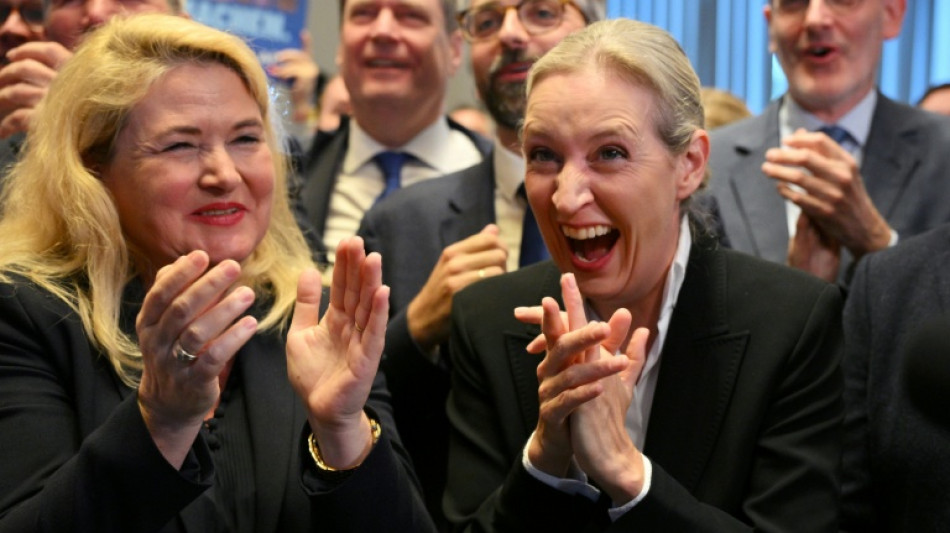
Cheering and clapping, Germany's far-right AfD celebrated another regional election win Sunday as exit polls placed it narrowly ahead in a Baltic Sea coastal state in the formerly communist east.
"We are the strongest force and have reached the mainstream of the population," said jubilant AfD co-leader Alice Weidel after the first results came in for Mecklenburg-Western Pomerania state.
"We have displaced the CDU as the people's party," she later added, referring to the centre-right party of embattled Chancellor Friedrich Merz that was hovering around a historic low of five percent in the region.
The AfD scored more than 37 percent against about 35 for the centre-left Social Democrats (SPD) of state premier Manuela Schwesig, who had hoped for a last-minute comeback after recently closing the gap with the anti-immigration AfD.
Schwesig nevertheless looked likely to remain in office as a three-way coalition of her SPD with two other left-wing parties -- the Greens and the hard-left Die Linke -- appeared headed for a majority.
The other national AfD boss, Tino Chrupalla, described his party's success -- which came two weeks after an AfD triumph in Saxony-Anhalt state -- as a "sensational result", adding that "we clearly have a mandate to govern".
The AfD's hopeful for state premier, former radio host Leif-Erik Holm, 56, immediately claimed that mandate. "We will, of course, invite all parties," he said at the AfD's election party in the state capital Schwerin.
But he also acknowledged that "it's difficult to form a government" as none of the other major parties are willing to form a coalition with the AfD.
- 'Changing times' -
Thomas Pfetzner, a local AfD party member, was nonetheless jubilant about the outcome.
"It is fantastic, I would say," he told AFP. "We would have liked a bit more, of course. But it is a fantastic result. I mean, we more than doubled our vote -- everything is fine.
"You should certainly cooperate with a democratic force that has nearly 40 percent of the vote, and naturally, you should talk to that democratic force."
AfD politicians, functionaries and supporters toasted the win with mugs of beer at a pub in Schwerin, the state capital.
The crowd jeered Merz, whose CDU crashed to just over five percent of the vote, barely scraping back into the state parliament.
Jan-Phillip Tadsen, an AfD MP in the state parliament, told AFP that Merz's stumbles and failures to push through promised reforms -- including a crackdown on immigration -- had helped fuel his party's surge across Germany.
"I believe these election results are a sign of the changing times across Germany," Tadsen told AFP just after cheering the latest vote tally. "We've achieved a level of strength here in Mecklenburg-Western Pomerania that society at large can no longer ignore."
Holm, born in Schwerin, completed an apprenticeship as an electrician and studied economics, before he worked for years as a radio presenter for public broadcaster NDR and several private stations.
Holm joined the AfD during its founding phase and assumed the state chairmanship in 2013. He was elected to the state parliament in 2016 and has been a member of the national parliament since 2017.
If he were to lead an AfD government, Holm has promised to build a state deportation centre for rejected asylum seekers and ban gender-inclusive language in public administration.
Unlike in some other German states, the AfD's state branch in Mecklenburg-Western Pomerania is not under surveillance by the domestic intelligence service BfV as a suspected right-wing extremist group.
A.Hill--SMC