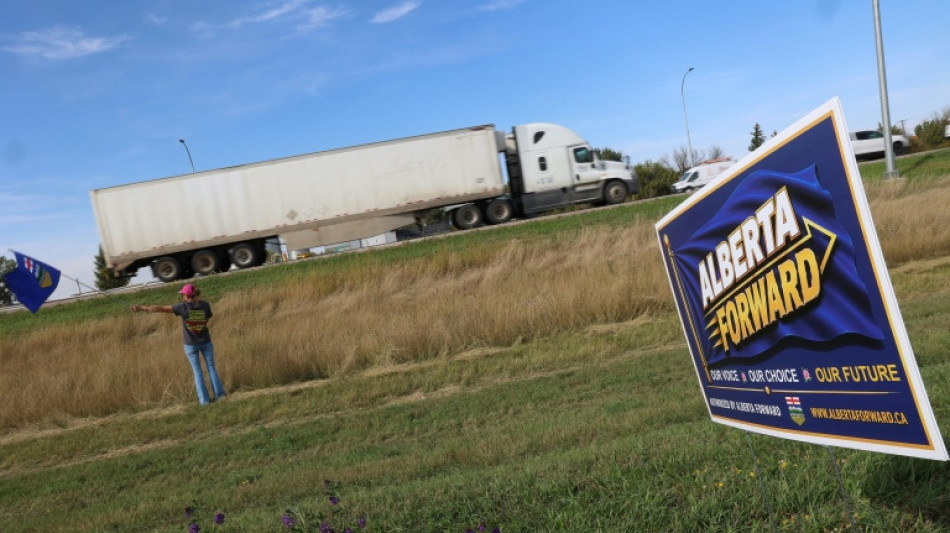
Carney campaigns for Canadian unity before Alberta secession vote / Photo: ABED ZAQ - AFP

 London
 18 °C
18 °C
 Manchester
 14 °C
14 °C
 Glasgow
 13 °C
13 °C
 Dublin
11 °C
Dublin
11 °C
 Belfast
11 °C
Belfast
11 °C
 Washington
19 °C
Washington
19 °C
 Denver
 11 °C
11 °C
 Atlanta
 30 °C
30 °C
 Dallas
31 °C
Dallas
31 °C
 Houston Texas
32 °C
Houston Texas
32 °C
 New Orleans
 30 °C
30 °C
 El Paso
22 °C
El Paso
22 °C
 Phoenix
27 °C
Phoenix
27 °C
 Los Angeles
29 °C
San Diego
28 °C
San Francisco
22 °C
Chicago
16 °C
Minneapolis
Los Angeles
29 °C
San Diego
28 °C
San Francisco
22 °C
Chicago
16 °C
Minneapolis
 9 °C
Seattle
14 °C
Portland
22 °C
Salt Lake City
14 °C
Las Vegas
23 °C
Miami
32 °C
Jacksonville
30 °C
San Antonio
30 °C
Bermuda
27 °C
Nassau
18 °C
Iqaluit
-1 °C
Yellowknife
6 °C
Anchorage
5 °C
Fairbanks
2 °C
Barrow
-12 °C
Calgary
9 °C
Edmonton
30 °C
Winnipeg
8 °C
Goose Bay
11 °C
Halifax
16 °C
Boston
17 °C
Ottawa
12 °C
Toronto
10 °C
Detroit
16 °C
Cleveland
20 °C
New York
18 °C
Baltimore
18 °C
Philadelphia
20 °C
Nuuk (Godthåb)
1 °C
Hong Kong
26 °C
Singapore
27 °C
Melbourne
30 °C
Canberra
8 °C
Adelaide
15 °C
Darwin
27 °C
Perth
14 °C
Fort Worth
29 °C
Honolulu
26 °C
Sydney
9 °C
Seattle
14 °C
Portland
22 °C
Salt Lake City
14 °C
Las Vegas
23 °C
Miami
32 °C
Jacksonville
30 °C
San Antonio
30 °C
Bermuda
27 °C
Nassau
18 °C
Iqaluit
-1 °C
Yellowknife
6 °C
Anchorage
5 °C
Fairbanks
2 °C
Barrow
-12 °C
Calgary
9 °C
Edmonton
30 °C
Winnipeg
8 °C
Goose Bay
11 °C
Halifax
16 °C
Boston
17 °C
Ottawa
12 °C
Toronto
10 °C
Detroit
16 °C
Cleveland
20 °C
New York
18 °C
Baltimore
18 °C
Philadelphia
20 °C
Nuuk (Godthåb)
1 °C
Hong Kong
26 °C
Singapore
27 °C
Melbourne
30 °C
Canberra
8 °C
Adelaide
15 °C
Darwin
27 °C
Perth
14 °C
Fort Worth
29 °C
Honolulu
26 °C
Sydney
 13 °C
Johannesburg
24 °C
Dubai
13 °C
Johannesburg
24 °C
Dubai
 33 °C
Mumbai
32 °C
Zürich
15 °C
Tokyo
18 °C
Seoul
15 °C
Delhi
21 °C
Beijing
10 °C
Riyadh
32 °C
Prague
13 °C
Pennsylvania
19 °C
Valletta
21 °C
Manama
32 °C
Warsaw
10 °C
Stockholm
10 °C
33 °C
Mumbai
32 °C
Zürich
15 °C
Tokyo
18 °C
Seoul
15 °C
Delhi
21 °C
Beijing
10 °C
Riyadh
32 °C
Prague
13 °C
Pennsylvania
19 °C
Valletta
21 °C
Manama
32 °C
Warsaw
10 °C
Stockholm
10 °C
Canadian Prime Minister Mark Carney campaigned for national unity in Alberta on Thursday, before the oil-rich province votes on whether it wants a binding independence referendum.
Polling indicates less than a quarter of Alberta's roughly five million people want to break away from Canada, but Carney, who grew up in the western province, said "polls don't vote."
"We need people to show up and vote and stand up for Alberta, stand up for Canada," he said during a television interview in Calgary.
Speaking later with local business leaders, Carney said he couldn't think of a "worse time to have a referendum," citing a "more dangerously divided world" and friction with the United States.
Alberta's right-wing Premier Danielle Smith says she is against independence but called Monday's non-binding vote to settle a divisive issue.
If a majority votes for independence, she has committed to launching a legally binding separation process. If a majority votes to stay, Smith says she won't approve another referendum.
Mitch Sylvestre, who heads the Alberta Prosperity Project, a prominent separatist organization, told AFP his side might "actually win this referendum."
"I would be very surprised if we got less than 40 percent," he said in an interview on Tuesday.
- Oil in focus -
Carney has put Alberta's oil industry at the center of his plans to solidify Canada's economy and reduce dependence on the United States, warning close economic ties have been permanently fractured by President Donald Trump.
Carney has backed a new pipeline and other projects to increase crude production, marking a clear break from his predecessor, Justin Trudeau, who was broadly reviled in Alberta over allegations he stifled oil industry growth in favor of environmental policies.
Carney has repeatedly cited the proposed pipeline to argue for Alberta's future prosperity within a united Canada.
Alberta separatists voice familiar conservative frustrations, from concerns about immigration levels to generalized fears about fraying individual liberty, but their grievances often hinge on oil industry management.
Smith told the CBC that Alberta separatists stepped up mobilization because Trudeau, who left office last year, was "actively trying to kill" the oil industry.
Oil's dominance in separatist discussion makes Alberta "mostly an outlier," said Syracuse University professor Ryan Griffiths, an expert on global secessionist groups.
Secessionist movements regularly have "economic motivations," but typically those are married to a linguistic or nationalist component, Griffiths said.
"There's no magic line" dictating what defines a nation, he told AFP, but noted Alberta's case for nationhood appears harder to make than that of other groups, like Catalans, Scots and French-speaking Canadians in Quebec.
- American influence? -
The alleged influence of Trump allies in Alberta has attracted intense scrutiny in Canada.
Treasury Secretary Scott Bessent has called Alberta a "natural partner" for the United States, and Alberta Prosperity Project leaders held several meetings at the State Department.
Earlier this month, Canada's Globe and Mail newspaper detailed contacts between Sylvestre, his team and Republican Party operatives.
Sylvestre told AFP that, for him, US interests "don't play any role" in Alberta "until we win and become government," at which point he would work to ensure free-flowing trade.
"There's no animosity towards America here," he said. "I can't see why we wouldn't want to continue trading with the biggest economy in the world."
Asked about alleged foreign interference on Thursday, Carney said: "our expectation is -- to be absolutely clear on foreign governments, United States included -- we don't get ourselves involved in their elections, they don't get themselves involved in our elections."
L.Mitchell--SMC