Garmin Patent Reveals Inter-Pixel Solar Tech for AMOLED Watches


 London
 9 °C

 Manchester
 8 °C
 Glasgow
7 °C
 Dublin
11 °C
 Belfast
9 °C
 Washington
9 °C
 Denver
4 °C
 Atlanta
 14 °C
 Dallas
15 °C
 Houston Texas
 15 °C
 New Orleans
 17 °C
 El Paso
 12 °C
 Phoenix
12 °C
 Los Angeles
11 °C
San Diego
11 °C
San Francisco
8 °C
Chicago
11 °C
Minneapolis
14 °C
Seattle
 1 °C
Portland
1 °C
Salt Lake City
 1 °C
Las Vegas
7 °C
Miami
23 °C
Jacksonville
21 °C
San Antonio
14 °C
Bermuda
23 °C
Nassau
11 °C
Iqaluit
-15 °C
Yellowknife
-14 °C
Anchorage
-2 °C
Fairbanks
-16 °C
Barrow
-2 °C
Calgary
-5 °C
Edmonton
5 °C
Winnipeg
 3 °C
Goose Bay
7 °C
Halifax
3 °C
Boston
9 °C
Ottawa
2 °C
Toronto
5 °C
Detroit
5 °C
Cleveland
9 °C
New York
11 °C
Baltimore
10 °C
Philadelphia
11 °C
Nuuk (Godthåb)
-8 °C
Hong Kong
20 °C
Singapore
28 °C
Melbourne
22 °C
Canberra
17 °C
Adelaide
 30 °C
Darwin
30 °C
Perth
17 °C
Fort Worth
16 °C
Honolulu
 23 °C
Sydney
 21 °C
Johannesburg
26 °C
Dubai
29 °C
Mumbai
28 °C
Zürich
10 °C
Tokyo
11 °C
Seoul
-4 °C
Delhi
22 °C
Beijing
-2 °C
Riyadh
29 °C
Prague
7 °C
Pennsylvania
4 °C
Valletta
23 °C
Manama
27 °C
Warsaw
2 °C
Stockholm
0 °C
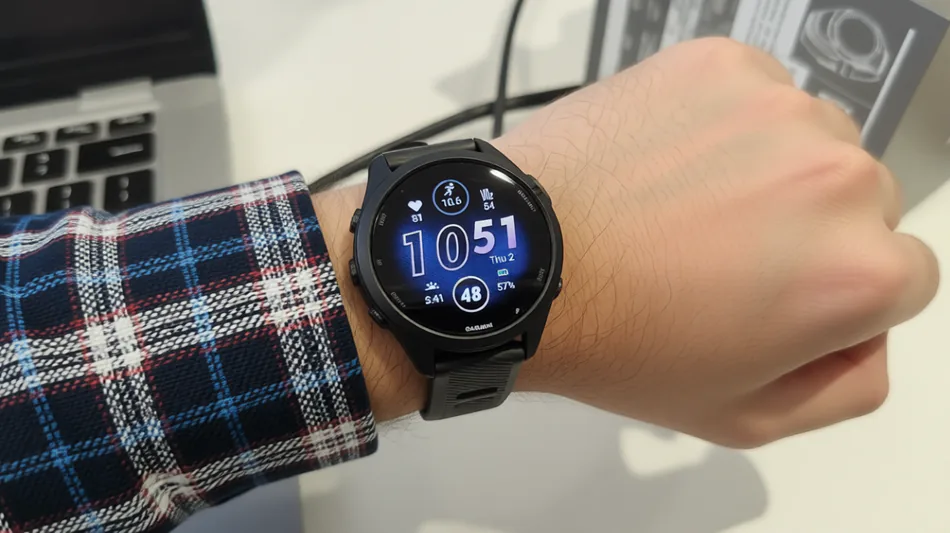
Garmin is researching a novel approach to extend battery life in its smartwatches by integrating miniature solar cells directly between the pixels of AMOLED displays. This technology could eliminate the need for external solar rings or layers that often compromise screen quality, potentially narrowing the endurance gap between OLED and MIP screens.
Garmin is exploring a method to significantly extend the battery life of its AMOLED smartwatches by embedding miniature solar cells directly between the display pixels. A recently published patent, identified as number 20260362887, outlines this technology, which aims to provide continuous power generation while the watch is worn without requiring users to seek external charging sources.
The proposed design integrates solar harvesting components into the display matrix itself. This approach contrasts with current Garmin implementations that typically place a complete solar layer over the screen or utilize a solar ring around the bezel. According to the patent details, embedding cells between pixels would remove the need for an overarching solar layer, which can often cause a dimming effect on the watch face. By avoiding this additional layer, the technology could allow AMOLED screens to maintain higher clarity and crispness.
This development addresses a longstanding limitation of OLED displays in wearable technology. While AMOLED screens offer superior color vibrancy and contrast compared to Memory-in-Pixel (MIP) displays, they have historically suffered from shorter battery endurance. Garmin currently utilizes both display technologies across its product lineup, with MIP screens favored for their efficiency in high-visibility outdoor conditions.
The timing of the patent publication coincides with recent statements from Garmin’s leadership regarding the company's dual-display strategy. Brad Trenkle, Garmin’s Chief Operating Officer, recently discussed the performance differences between OLED and MIP technologies. He noted that while the battery life gap has narrowed significantly over recent generations, it has not yet fully converged.
Trenkle stated that the difference in endurance is substantial enough that MIP technology will not be completely phased out in the near future. However, when asked whether in-screen solar integration would necessarily degrade the viewing experience of an AMOLED display, Trenkle responded that it would not, describing the concept as a viable thought experiment.
Although Trenkle did not confirm that Garmin is actively developing inter-pixel solar cells for immediate release, his comments suggest openness to technologies that enhance OLED efficiency without compromising visual quality. The patent describes a system where solar units could be housed in various configurations, potentially including rings around the watch face, but the inter-pixel approach offers distinct advantages in terms of display area utilization.
If successfully implemented in future products, this technology could eliminate one of the primary advantages MIP displays hold over OLEDs: battery longevity. An all-AMOLED future for Garmin fans would depend on whether this patent translates into commercial hardware that delivers reliable power generation while maintaining the aesthetic benefits of organic light-emitting diodes.
The patent application highlights Garmin’s ongoing efforts to balance display quality with functional endurance. Current models, such as those in the Fenix series, often rely on solar rings to boost battery life, but these designs can result in larger watch cases or reduced screen real estate. The inter-pixel method described in the patent offers a more integrated solution that preserves the sleek profile of modern smartwatches.
Garmin has not announced a release date for any devices utilizing this specific technology. The company continues to refine its existing OLED and MIP offerings, with Trenkle indicating that both technologies will remain part of the portfolio until their performance metrics align more closely. The patent serves as an indicator of the direction in which Garmin’s display engineering may head as it seeks to optimize power consumption in high-resolution wearable displays.
J.Hall--SMC